
Turn Your 26.2 Miles Into Marathon Route Poster Art for Runners
WallfullyA minimalist route line, a photo collage with a route inset, and a medal-and-map layout are the fastest ways to turn a finish-line memory into a wall piece worth keeping. Whichever style you pick, always anchor it with the race name, date, and finish time. Everything else, from landmark icons to elevation badges, builds on that foundation. The sections below cover materials, layout tips, and the exact steps to get one made.
TL;DR:
- A simple continuous route line design is the most versatile and scales well for different display sizes, making it highly recommendable for quick visual impact.
- Using accurate GPX data ensures the route’s correctness, but smooth, simplified lines are preferred aesthetically, especially if GPS noise is present.
- Materials like museum-grade paper or aluminum offer better durability and resistance to aging, especially for posters intended to last decades.
- Including essential details such as race name, date, distance, your name, and finish time is non-negotiable, with optional add-ons like bib number or split times for deeper personalization.
- Professional printing services provide live previews, higher quality finishes, and customization options that surpass DIY efforts, ensuring a lasting keepsake.
Table of Contents
- Creative Marathon Route Poster Ideas That Actually Work
- What to Put on Your Poster and How to Get the Route Right
- Choosing Materials, Sizes, and Framing for Your Poster
- Design Tips and Slogan Ideas for Marathon Posters
- DIY Poster Design Versus Ordering a Custom Print
- Why a Professionally Printed Poster Beats a DIY Print Job
- The Poster That Means More Than the Medal
- Order Your Custom Marathon Route Poster With Wallfully
- Sources
- FAQ
Creative Marathon Route Poster Ideas That Actually Work
Some designs age well on a wall for decades. Others feel busy the moment you hang them. The ideas below come from what actually reads clearly at a glance, because a poster you walk past every day has to work in about two seconds.
-
The route-as-line design. Strip the map down to a single continuous line tracing 26.2 miles, with a small dot or flag marking start and finish. No street names, no clutter. A single-line route is one of the most recommended poster motifs precisely because it’s iconic even at a glance, and it scales down beautifully for smaller frames or up for a statement piece over a couch.
-
Map with landmarks. This version keeps the route line but adds context: a skyline silhouette for a city race, a highlighted bridge or park you crossed, maybe a compass rose. It works well for races with a strong sense of place, like a coastal marathon or one that runs past recognizable monuments.
-
Photo collage with a route inset. Instead of leading with the map, this design leads with your face at mile 20, your family at the finish line, or the crowd at a cheer station. A small route line sits in a corner as a quiet detail. This suits runners who care more about the emotional record of the day than the geography of it.
-
Data-driven finisher poster. Built around numbers: finish time in large type, splits by mile, an elevation profile running along the bottom like a heartbeat monitor. Good for data-minded runners and anyone chasing a personal record who wants proof of the effort.
-
Medal-and-bib showcase. A close-up photo or illustration of your medal and bib, paired with a smaller map inset in a corner. Balance matters here. Let the medal dominate about two-thirds of the space, so the map reads as a supporting detail rather than competing for attention.
For gallery walls or smaller spaces, combine a minimalist route line with a compact bib block underneath. It reads as one cohesive statement instead of two competing ideas. Marathon poster inspiration galleries are worth browsing if you want to see how these five approaches look side by side before committing to one.
What to Put on Your Poster and How to Get the Route Right
The core details are non-negotiable: race name, date, distance, your name, and finish time. Those five facts turn a generic map into a personal record. Beyond that, you’re choosing what adds meaning without cluttering the design.
Optional additions worth considering:
- Bib number, especially if it has personal significance (a lucky number, a memorial dedication)
- Mile splits for runners who care about pacing
- Charity name if you ran for a cause
- A short quote or mantra that got you through mile 22
Getting the route data right depends on how precise you want to be. Most runners export a GPX or TCX file directly from Strava or a Garmin watch, which captures the exact path you ran, including any wrong turns or water-stop detours. Race organizers sometimes publish official course maps too, which give you the intended route rather than your personal wandering version. Manual tracing is the third option, useful if you don’t have a GPS file or want a cleaner, more artistic line than your actual GPS track produced.
Exact GPX data gives you accuracy. A simplified, hand-smoothed line gives you aesthetics. Most poster makers actually prefer the second option, since raw GPS data often includes jagged noise from satellite drift that looks messy blown up to poster size.
Pro Tip: If you’re sharing your GPX file with an online poster service, check whether your Strava privacy settings expose your home address as a start or end point. Crop the route slightly or use “privacy zones” before uploading, so your finished poster doesn’t accidentally broadcast where you live.
Choosing Materials, Sizes, and Framing for Your Poster
The substrate you choose determines how the poster looks in ten years, not just on day one.
- Matte or satin paper is the standard choice, affordable and glare-free under most lighting.
- Museum-grade paper costs more but resists yellowing and holds ink detail longer, worth it for a poster you plan to keep for decades.
- Aluminum dibond gives a sleek, modern look with no frame needed, good for minimalist route-line designs in a home office or gym.
- Canvas adds texture and warmth, better suited to photo-collage styles than data-heavy designs.
For sizing, 18×24 inches works well for hallways or above a desk, while 24×36 inches suits a living room or stairwell as a statement piece, the same size logic event marketers use for high-visibility street posters. A simple black frame with a mat border tends to outlast trendier frame styles. Keep any print away from direct sunlight, since UV exposure fades colored ink faster than you’d expect, and avoid bathrooms or laundry rooms where humidity can warp paper over time. Standard paper prints typically ship within a week; aluminum and canvas usually take a few days longer due to mounting.
Design Tips and Slogan Ideas for Marathon Posters
One focal element, one message. That’s the rule most poster designers keep coming back to, and it’s why event marketing guides recommend keeping sponsor logos and secondary details subordinate to the main visual and headline. Your finish time or your route line should be the thing the eye lands on first.
Color matters more than most people expect. A muted background, charcoal, cream, deep navy, makes a bright route line pop instead of competing with it. Typography should match the mood: a bold condensed font for energy, a thin serif for something more elegant and timeless. Your name and finish time deserve the largest type after the race name itself.
Slogans work best when they’re grouped by tone:
- Motivational: “26.2 miles of proving it to myself.”
- Humorous: “I ran 26.2 miles for this poster.”
- Commemorative: “Every mile had a reason.”
Motivational slogans that lean into community pride, personal challenge, or local landmarks tend to land better than generic phrases, because they connect to something specific about your race rather than marathons in general. If you’re adding a slogan alongside your data, keep it small and place it below the map, never overlapping the route line itself.
DIY Poster Design Versus Ordering a Custom Print
The DIY path: export your GPX file, import it into a free map editing tool, simplify the line so it’s clean rather than jagged, export at high resolution (300 DPI minimum for print), then send the file to a local print shop or an online printing service. Expect one to two weeks total if you’re doing your own design work and troubleshooting print settings yourself.
The custom-service path looks different:
- Upload your GPX file or simply enter your race name and date if you don’t have GPS data.
- Choose your layout, size, and material.
- Review a digital proof before anything goes to print.
- Approve and place your order, then wait for production and shipping.
Starting the design process three to four months before you need the finished poster gives you room for revisions if something looks off in the proof, whether that’s a gift deadline or your own living room wall. Cost climbs with material quality. Archival inks resist fading longer, aluminum mounting skips the frame entirely, and pre-framed options save you a separate trip to a frame shop. Before ordering anything, double-check your finish time, the spelling of your name, and the race date against your official results. A typo on a keepsake is much harder to fix after it’s printed.
Why a Professionally Printed Poster Beats a DIY Print Job
A guided customization tool with live previews means you see your exact route, name, and finish time rendered before committing to anything. The service pairs customization with high-quality, eco-friendly printing and a satisfaction guarantee, which matters most when you’re paying for something meant to last on a wall, not sit in a drawer.
The Poster That Means More Than the Medal
A medal goes in a drawer. A poster stays on the wall, which is why the route line matters more than people expect. It’s not decoration, it’s proof you covered that exact ground on that exact day.
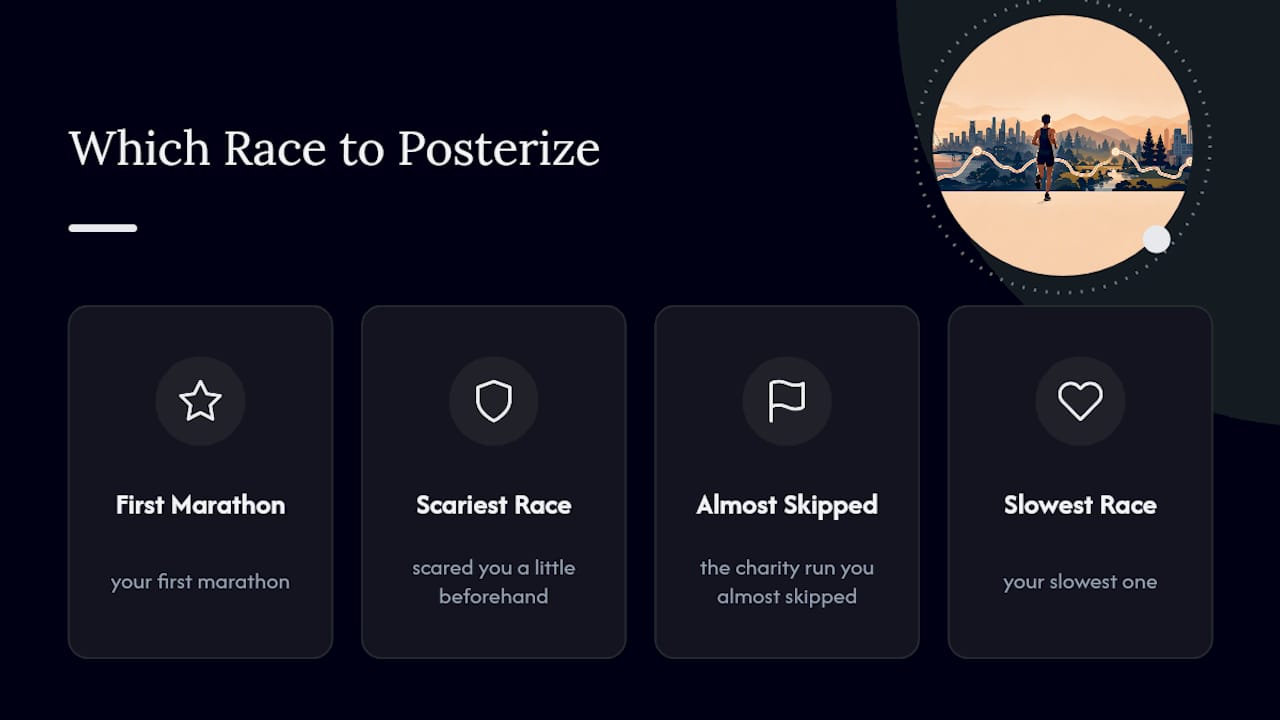
If you’re deciding which race deserves the wall space, pick the one that scared you a little beforehand, your first marathon, your slowest one, or the charity run you almost skipped. Those are the ones worth turning into something permanent.
— Luanda
Order Your Custom Marathon Route Poster With Wallfully
This service turns your GPX file or race details into a finished keepsake without the trial-and-error of DIY design software. You get guided customization with a live preview before you pay, a choice of eco-friendly print materials, optional framing, and free shipping backed by a satisfaction guarantee.
Before you start, gather your race name, date, and finish time, plus your GPX file if you have one (Strava and Garmin both let you export it in a few clicks). Pick your preferred size based on where the poster will hang, a hallway favors something smaller. A living room can handle a statement piece. If you’d rather build around race-day photos instead of a route line, Wallfully’s photo collage collection covers that too. When you’re ready, browse the Route & Map Posters collection and preview your design before you commit to anything.
Sources
For deeper guidance on poster timing, sizing, and cost considerations, see the UPrinting guide to running event poster marketing, Marathoners.run’s poster idea roundup, and Outside Online’s breakdown of marathon costs. MarathonGuide’s essay on community and connection is worth reading if you want more on why these posters resonate emotionally.
FAQ
What Should Go on a Marathon Finisher Poster?
At minimum, include the race name, date, distance, your name, and finish time. Optional additions like bib number, mile splits, a charity name, or a short personal quote add meaning without cluttering the core design.
Does It Really Cost Over $300 to Run a Marathon?
Race-related costs vary widely depending on entry fees, travel, gear, and training expenses, and some runners’ total spending does climb well past $300 once everything is added up. That variability is also why some runners choose a simple DIY poster while others invest in a professionally printed keepsake to match the effort they put into race day.
What Are Some Good Marathon Slogans for a Poster?
Strong slogans lean into personal challenge, community pride, or local landmarks rather than generic phrases. Try something specific to your race, like referencing a hill you dreaded or a neighborhood that cheered you on, since slogans built around community and place tend to resonate more than a stock motivational quote.
What Are Fun Theme Ideas for a Marathon Poster?
Popular themes include a data-driven design centered on splits and elevation, a medal-and-bib showcase, or a photo collage built around race-day emotion rather than the map itself. Runners who ran for a cause often build the poster around their fundraising theme, pairing the charity name with the route line.
Can Wallfully Make a Poster From My Strava GPX File?
Yes. Wallfully’s guided customization tool accepts your GPX or route details and shows you a live preview before you order, so you can check accuracy before committing to print.