
Image Rights for Printing in the U.S.: 3 Quick Checks Before You Print
WallfullyPrinting a photo you didn’t take usually requires permission from whoever holds the copyright, because reproduction rights belong to the creator the moment the image exists. Safe workarounds exist: public domain works, U.S. government images, Creative Commons licenses that allow printing, and stock photos you’ve actually paid for. A single private print carries low enforcement risk, but “low” isn’t “zero.” When you’re not sure, get permission in writing or stick to a source that’s already cleared for use.
TL;DR:
- Printing copyrighted images without permission can lead to legal issues unless the work is in the public domain, a government creation, or licensed for printing.
- You can freely reproduce images only if they are public domain, government-created, licensed under allowances like Creative Commons CC0 or CC BY, or purchased with a license permitting printing.
- When uncertain, obtain written permission or a signed print release from the rights holder, and keep proof of licensing or authorization with the image file.
- Print shops often decline reproducing copyrighted works without verified rights or permissions, so having documentation is essential to avoid refusals.
- AI-generated images currently do not qualify for copyright protection, and fair use typically does not apply to printing unaltered, copyrighted photographs for personal display.
Table of Contents
- Quick Checklist: Three Questions to Run Before You Print
- Who Owns an Image and How to Check
- When You Can Print Without Asking Anyone
- Getting Permission or a Print Release, Step by Step
- Printers, Labs, and What Happens if You Get Refused
- Wallfully’s Approach to Sourcing and Clearing Images
- Turn a Legally Cleared Photo Into a Print You’ll Actually Hang
- Sources
- FAQ
Quick Checklist: Three Questions to Run Before You Print
Before you send anything to a printer, run it through three questions. If you can’t answer yes to at least one, stop and either find a cleared source or track down permission.
- Is the image public domain or a work created by a U.S. government agency?
- Does it carry a license, Creative Commons or stock, that specifically allows printing for your intended use?
- Do you have written permission or a signed print release from the person or company that owns it?
Pro Tip: Screenshot or save your license proof (the CC badge, the stock receipt, the email granting permission) in the same folder as the image file. Print labs and rights holders both tend to ask for it later, not before.
Here’s the part most people skip: even when you’re confident your use qualifies as fair use, that confidence doesn’t transfer to a print shop. The U.S. Copyright Office’s fair-use FAQ notes that copy shops have been sued for reproducing copyrighted work and often refuse jobs rather than assess your legal reasoning for you.
Who Owns an Image and How to Check
Copyright attaches automatically the moment a photo is taken or an image is created. Registration with the Copyright Office strengthens a legal claim and is required before filing an infringement lawsuit, but it’s not what creates the right in the first place. That means an unregistered photo on someone’s Instagram is just as protected as one filed with the government.
Tracking down the actual owner takes a bit of detective work:
- Check the file’s embedded metadata (EXIF data) for a photographer’s name, camera details, or copyright notice.
- Run a reverse image search to find the original posting and any licensing information attached to it.
- Search Library of Congress catalogs, which often include rights and restrictions statements on archival photos.
- Check U.S. Copyright Office public records for registered works tied to a known creator.
The tricky category is the orphan work, an image whose owner you genuinely can’t identify after a real search. There’s no statutory safe harbor for using one anyway. The Library of Congress is explicit that it generally doesn’t own the copyright in its own collections and expects users to make their own assessment before reproducing anything, rights statement or not. If you can’t find an owner, treat the image as protected and either skip it or accept the (small but real) risk consciously.
When You Can Print Without Asking Anyone
Four categories give you a real, defensible reason to print without hunting down a rights holder.
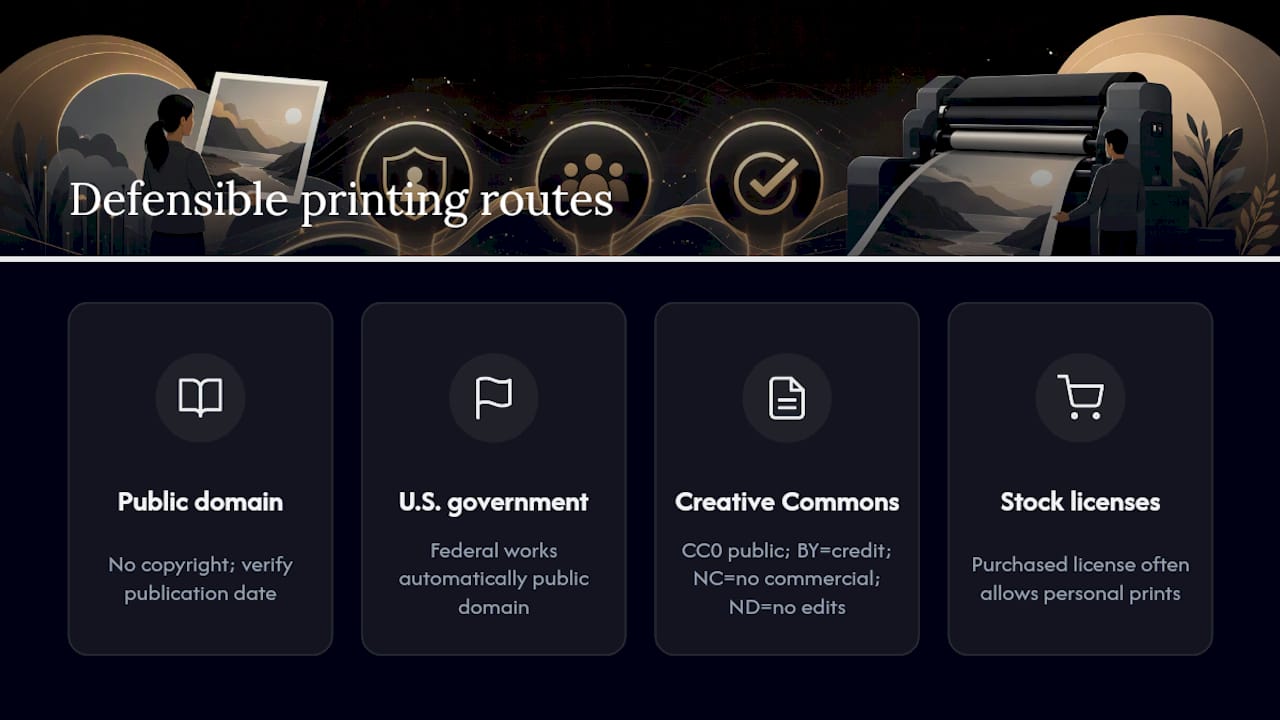
Public domain works have no active copyright, either because the term expired (generally works published long enough ago in the U.S., with some later dates possible) or because the creator dedicated it to the public via a CC0 license. Verify the date, don’t assume it.
U.S. government works created by federal employees as part of their official duties are automatically public domain. NASA photos, National Park Service images, and most federal agency content fall here.
Creative Commons licenses vary in what they allow. CC0 puts a work fully in the public domain; CC BY lets you print it as long as you credit the creator; CC BY-NC blocks any commercial use, including reselling prints; CC BY-ND lets you print the original but not an altered or cropped version.
Stock photo licenses you’ve purchased typically cover personal printing, though terms vary by vendor, some cap the number of reproductions or require an “extended license” for merchandise or resale.
Fair use, governed by 17 U.S.C. §107, rarely helps here. The four factors, purpose, nature of the work, amount used, and market effect, are built around transformation and commentary, not simply hanging someone’s unaltered photo on your wall. Printing a full image for personal display is close to the least defensible fair-use scenario there is.
One evolving wrinkle: the Copyright Office has said that images generated entirely by AI, with no meaningful human creative input, currently don’t qualify for copyright protection at all, though that guidance is still developing.
Getting Permission or a Print Release, Step by Step
If none of the exceptions apply, you need permission from the rights holder. It’s rarely as hard to get as people assume, especially for personal or small-run use.
- Identify the copyright owner (often the photographer, not the person or subject in the photo) and reach out in writing, email works fine.
- Specify exactly what you want: image size, number of copies, whether the use is personal or commercial, and whether you’ll be modifying it.
- Ask for a signed print release covering reproduction rights, scope, duration, and any commercial restrictions, plus explicit language that vendors and print labs are authorized to fulfill the order.
- Confirm whether attribution is required, and if so, how they want to be credited.
- Save the signed release alongside the image file so you can produce it instantly if a lab asks.
Pro Tip: Professional photographers frequently have a standard print-release template ready to go. Ask if they have one before drafting your own; it saves everyone time and covers the bases a homemade agreement might miss.
Printers, Labs, and What Happens if You Get Refused
Print shops decline jobs more often than people expect, and it’s rarely arbitrary. Labs that reproduce copyrighted images without permission can be named in infringement suits themselves, so many err toward caution rather than evaluate your fair-use argument for you.
- Bring a signed print release or license documentation to avoid a refusal at the counter.
- Use verifiably licensed stock or public-domain sources when you don’t have a personal relationship with the creator.
- Choose a vendor whose policy explicitly accepts customer-supplied images without requiring proof of rights (this shifts risk to you, not them, so still keep your documentation).
- If you get a takedown notice or cease-and-desist, don’t ignore it. Respond promptly, remove the print listing if it’s for sale, and produce your permission documentation if you have it.
Wallfully’s Approach to Sourcing and Clearing Images
Wallfully builds its custom prints from sources that keep customers on solid ground: images you own outright, public-domain material, or properly licensed stock, never scraped or unverified web photos run through as-is. The preview and color-proof step in the ordering process exists partly for quality, but it also gives you a last checkpoint to confirm you’re printing the file you meant to license, not a substitute someone swapped in.
My practical checklist for anyone uploading a photo: confirm you took it, licensed it, or have a signed release for it before it ever reaches a cart. If you’re working from a photographer’s image for something like a milestone print or a collage, ask them directly for a release that names printing and reproduction, not just online sharing. That one sentence in an email avoids almost every dispute I’ve seen described in copyright guidance.
— Luanda
Turn a Legally Cleared Photo Into a Print You’ll Actually Hang
Once you know an image is cleared, whether it’s yours, public domain, or properly licensed, the next hurdle is usually turning it into something that looks good on a wall instead of a flat inkjet copy. That’s where Wallfully fits. You upload your own photos, preview the layout before committing to anything, and receive a finished piece printed with eco-friendly materials, along with shipping and a satisfaction guarantee.
If you’re combining several personal photos rather than printing one image, the Personalized Photo Collage Posters collection is built exactly for that, guided customization walks you through cropping, arranging, and previewing before you pay. Curious what the finished print quality actually looks like before you commit? Check how Wallfully previews personalized prints so you can see exactly what you’re getting.
Sources
- Fair Use (FAQ) — U.S. Copyright Office
- 17 U.S.C. §107 — Limitations on exclusive rights: Fair use
- Image Rights and Restrictions Statements — Library of Congress
- Can You Print Copyrighted Images for Personal Use? — LegalClarity
- Creative Commons license overview
FAQ
What legal rights does a photographer or artist have over an image?
Copyright grants the creator exclusive rights to reproduce, distribute, and publicly display their work, and those rights exist automatically once the image is created. Printing a copy without permission generally infringes on the reproduction right unless an exception like public domain status or a compatible license applies.
Can you legally print pictures you found on the internet?
Not automatically. Most images online are still protected by copyright even without a visible watermark or notice, so you need a license, a public domain source, or direct permission from the rights holder before printing.
What images can I use without asking for permission?
Public domain works, U.S. government agency photos, and images under a Creative Commons license that permits your intended use, like CC0 or CC BY, are generally safe. Always confirm the specific license terms since some CC licenses restrict commercial use or alterations.
What are printing rights, and how are they different from just owning a photo?
Printing rights refer to the specific permission to reproduce an image in physical form, which is separate from simply having a copy of the file on your device. A print release or license spells out exactly what you’re allowed to do, personal display, limited copies, commercial resale, and vendors like Wallfully rely on customers supplying images they actually have those rights to.
How risky is it to print a single photo for personal, non-commercial use?
The practical enforcement risk for one private print is low, but it isn’t nonexistent, and print shops themselves may decline the order regardless of your intentions. Sticking to cleared sources or getting written permission removes the guesswork entirely.