
How Free Shipping Works: What Shoppers Need to Know
WallfullyTL;DR:
- Free shipping often includes higher item prices, minimum purchase thresholds, or subscription fees rather than eliminating costs entirely. Retailers strategically use these models, encouraging unplanned spending and exploiting psychological triggers like the goal gradient effect and mental accounting. The UK and EU require greater pricing transparency, making real costs visible throughout the shopping process, unlike U.S. practices that often reveal delivery fees only at checkout.
Free shipping means you pay no separate delivery fee at checkout, but the cost of getting your order to your door never disappears. Retailers absorb it, redistribute it, or build it into the price you already paid. Understanding free shipping policies explained this way changes how you read every “free shipping” label you encounter. Whether you shop on Amazon in the USA, ASOS in the UK, or a boutique Australian store, the mechanics behind that offer shape what you pay, what you buy, and how quickly your order arrives. This guide breaks down exactly how free shipping works and what it means for your wallet.
How free shipping works: the main models retailers use
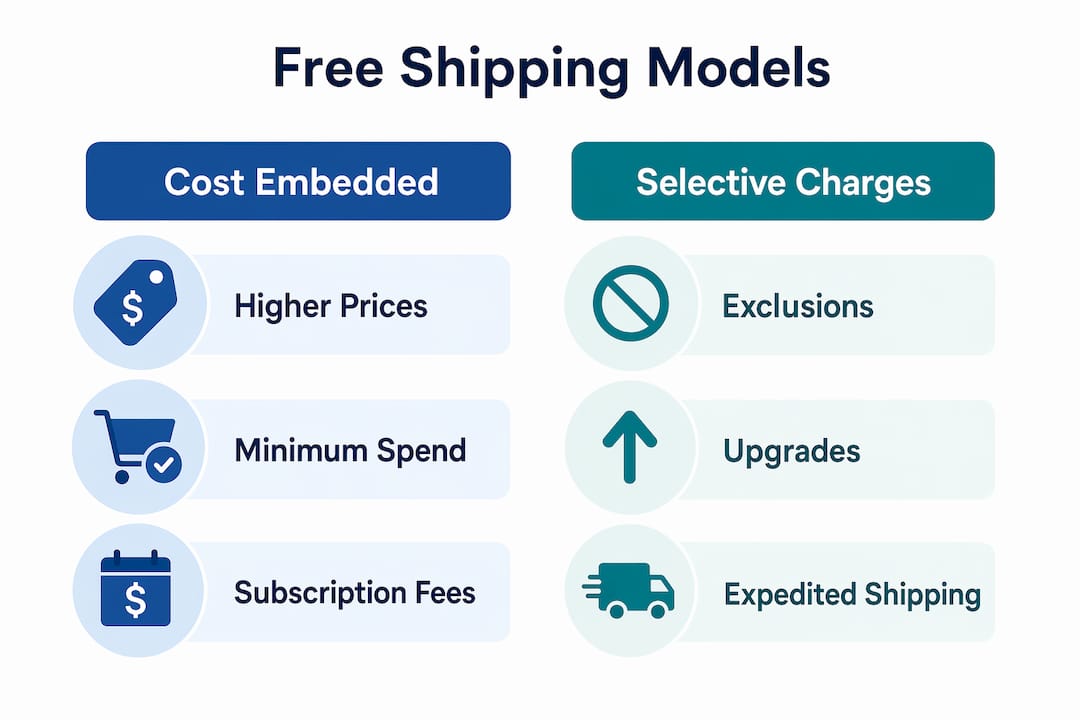
Free shipping is the industry term for zero-cost delivery at checkout, and retailers implement it through four distinct operational models. Each one shifts the cost somewhere else rather than eliminating it.
Price embedding is the most common and least visible method. Delivery costs are redistributed via higher item prices, so you never see a shipping line at checkout. A $30 candle at a store offering unconditional free shipping may cost $26 at a competitor that charges $4 for delivery. The total is identical. The word “free” just feels better.
Minimum spend thresholds are the second model, and they are deliberately calibrated. Many retailers set a cart value like $55 to qualify, sitting just above the average order value. This pushes you to add one more item rather than pay a $6 shipping fee. The retailer recovers the shipping cost through the extra revenue, and often profits beyond it.

Subscription and loyalty programs follow the Amazon Prime model. You pay an upfront annual or monthly fee, and subscription fees create perceived value that encourages more frequent shopping. The retailer bets that your increased purchase frequency will outpace the fulfillment costs your membership generates.
Selective exclusions and paid upgrades round out the picture. Heavy, oversized, or expedited shipping can be charged extra even when standard delivery is free. Remote regions, bulky furniture, and same-day delivery almost always fall outside the free shipping promise. Reading the fine print on any free shipping offer reveals these carve-outs quickly.
From a logistics standpoint, distributed fulfillment and carrier optimization are crucial for profitability. A retailer promising free two-day delivery needs warehouses close to customers, negotiated carrier rates, and sophisticated order routing. That infrastructure is expensive, and it is baked into the business model whether you see it or not.
Pro Tip: Before adding items to hit a free shipping threshold, check whether the retailer’s base prices are already higher than competitors who charge for delivery. A quick price comparison on one or two items tells you whether “free” is genuinely saving you money.
Why free shipping changes what you buy
Free shipping is more a psychological pricing strategy than a true cost elimination. It exploits two well-documented cognitive patterns that make shoppers spend more and feel better about doing it.
The first is the goal gradient effect. When you are $12 away from free shipping, your brain treats that threshold like a finish line. You accelerate toward it, adding items you might not have considered otherwise. Buyers often add unplanned items to reach free shipping thresholds, directly boosting retailer sales beyond shipping cost recovery. The retailer wins twice: the shipping cost is covered, and the basket size grows.
The second is mental accounting. A $0 delivery fee registers as a gain in your mind, not merely the absence of a cost. Research on consumer behavior shows that zero-cost delivery appears more valuable than it mathematically is, triggering a positive emotional response that nudges purchase completion. This is why free shipping reduces cart abandonment more effectively than an equivalent price discount.
Here is how these effects play out in real shopping behavior:
- You find a product you want, add it to your cart, and see you are $15 short of free shipping.
- You browse for something else to close the gap, often spending $20 to $25 on an item you did not plan to buy.
- You feel satisfied because you “saved” on shipping, even though your total spend increased.
- The reduced risk of free delivery also encourages ordering multiple sizes or colors to try at home.
That last point has a real downside. Returns rates increase with free shipping because reduced risk encourages riskier purchases and multiple orders. Retailers often absorb costly returns processing and logistics as a result. Some pass that cost back through stricter return windows or restocking fees, so the “free” experience can carry hidden friction on the way back.
“Free shipping is not a discount. It is a reframing of cost that changes what feels rational to buy.” This distinction matters every time you open your cart.
How pricing transparency rules affect free shipping in the UK and Europe
Shoppers in the UK and Europe have stronger legal protections around how free shipping offers are displayed than their counterparts in the USA or Australia. These protections exist because misleading delivery cost presentation is a recognized form of consumer harm.
The UK’s Competition and Markets Authority (CMA) has issued draft pricing guidelines that directly address delivery charges. UK pricing transparency rules mandate accurate display and running totals, requiring the full delivery charge to be included in the total price shown until a threshold is reached, then adjusted once the threshold is met. This means a UK retailer cannot show a low item price and reveal the delivery fee only at the final checkout screen.
The practical effect for shoppers is significant. A running cart total in a UK-compliant store already includes the delivery fee, so you see the real cost at every stage. Once your basket crosses the free shipping threshold, the total adjusts downward automatically. Transparency laws like the CMA guidelines shift digital pricing practices by making the true cost visible before you commit.
| Region | Pricing transparency requirement | Free shipping threshold display |
|---|---|---|
| United Kingdom | Full delivery cost shown in running total until threshold met | Cart total adjusts automatically once threshold is reached |
| European Union | Pre-contractual price disclosure required under Consumer Rights Directive | Varies by retailer; total price must be clear before purchase |
| United States | No federal mandate; practices vary widely by retailer | Threshold shown, but delivery fee often revealed only at checkout |
| Australia | Australian Consumer Law requires clear total pricing; ACCC enforces | Retailers must not mislead, but running total rules less prescriptive |
The contrast with US practice is stark. American retailers frequently show a product price, add shipping at the final checkout step, and rely on the shopper to do the math. This is a known driver of cart abandonment. For shoppers in the USA, the practical advice is to always navigate to the checkout summary before deciding whether a deal is competitive.
What to check before trusting a free shipping offer
Free shipping policies explained in full almost always contain conditions that change the value of the offer. Knowing what to look for protects you from spending more than you intended.
- Verify the final checkout total. Comparing final checkout totals including item price, shipping, and taxes gives you the real cost. A retailer with “free shipping” and higher item prices may cost more than a competitor charging $5 for delivery.
- Check threshold calculation rules. Free shipping thresholds can be computed on pre-discount or post-discount totals, and applied discounts during checkout can drop your cart below the qualifying amount. A coupon code that saves you $10 might simultaneously cost you free shipping.
- Read the exclusions list. Effective free shipping management requires nuanced shipping groups and zone exclusions to balance customer appeal with margin protection. Remote postcodes in Australia, Scottish Highlands addresses in the UK, and rural ZIP codes in the USA are frequently excluded.
- Understand the speed trade-off. Free shipping almost always means standard delivery, which can range from three days to three weeks depending on the retailer and your location. Expedited options nearly always carry a fee.
- Factor in the returns policy. If a retailer offers free outbound shipping but charges for returns, ordering multiple sizes to try at home is not actually free. Calculate the likely return cost before you add extra items.
Pro Tip: Let your cart sit for a day before adding items purely to hit a threshold. If you still want the extra item the next morning, add it. If not, pay the shipping fee. The fee is almost always cheaper than an unwanted purchase.
For shoppers interested in how e-commerce pricing strategies connect to free shipping offers, understanding whether a retailer uses price embedding or threshold models helps you compare true costs across stores.
Key takeaways
Free shipping never eliminates delivery costs. It redistributes them through higher prices, minimum spend requirements, or subscription fees, and understanding which model a retailer uses tells you what you are actually paying.
| Point | Details |
|---|---|
| Costs are always absorbed somewhere | Retailers embed shipping in item prices, subscriptions, or threshold-driven upsells. |
| Thresholds drive unplanned spending | The goal gradient effect pushes shoppers to add items, often spending more than the shipping fee itself. |
| UK and EU rules protect shoppers | CMA guidelines require full delivery costs in running totals, making true prices visible before checkout. |
| Exclusions are common | Oversized items, remote regions, and expedited delivery frequently fall outside free shipping promises. |
| Compare final totals, not labels | Always check the checkout summary including taxes and fees before judging whether a deal is competitive. |
Free shipping is a tool, not a gift
I have spent years watching shoppers, including myself, make decisions that felt rational in the moment but looked different on a bank statement. Free shipping is the single most effective lever retailers use to close a sale, and it works precisely because it does not feel like a sales tactic. It feels like a reward.
What I find genuinely interesting is how the cost structure behind free shipping mirrors the way airlines price seats. The base fare looks low, the extras add up, and the total is what it was always going to be. The difference is that airlines now face regulatory pressure to show total prices upfront. E-commerce is moving in the same direction, particularly in the UK and Europe, and I think that is good for everyone.
The retailers I respect most are transparent about it. Wallfully, for example, offers free shipping on all orders without a minimum spend threshold, which means the cost is absorbed into the product price and the offer is genuine. That model is honest. You know what you are paying, and you are not being nudged to add items you do not want.
My practical advice: treat free shipping as a feature to evaluate, not a reason to buy. If the product is right and the total price is competitive, free shipping is a genuine benefit. If you are adding items to a cart just to unlock it, stop and do the math. The shipping fee you are avoiding is almost always less than the extra purchase you are making to avoid it.
— Luanda
Shop with confidence at Wallfully
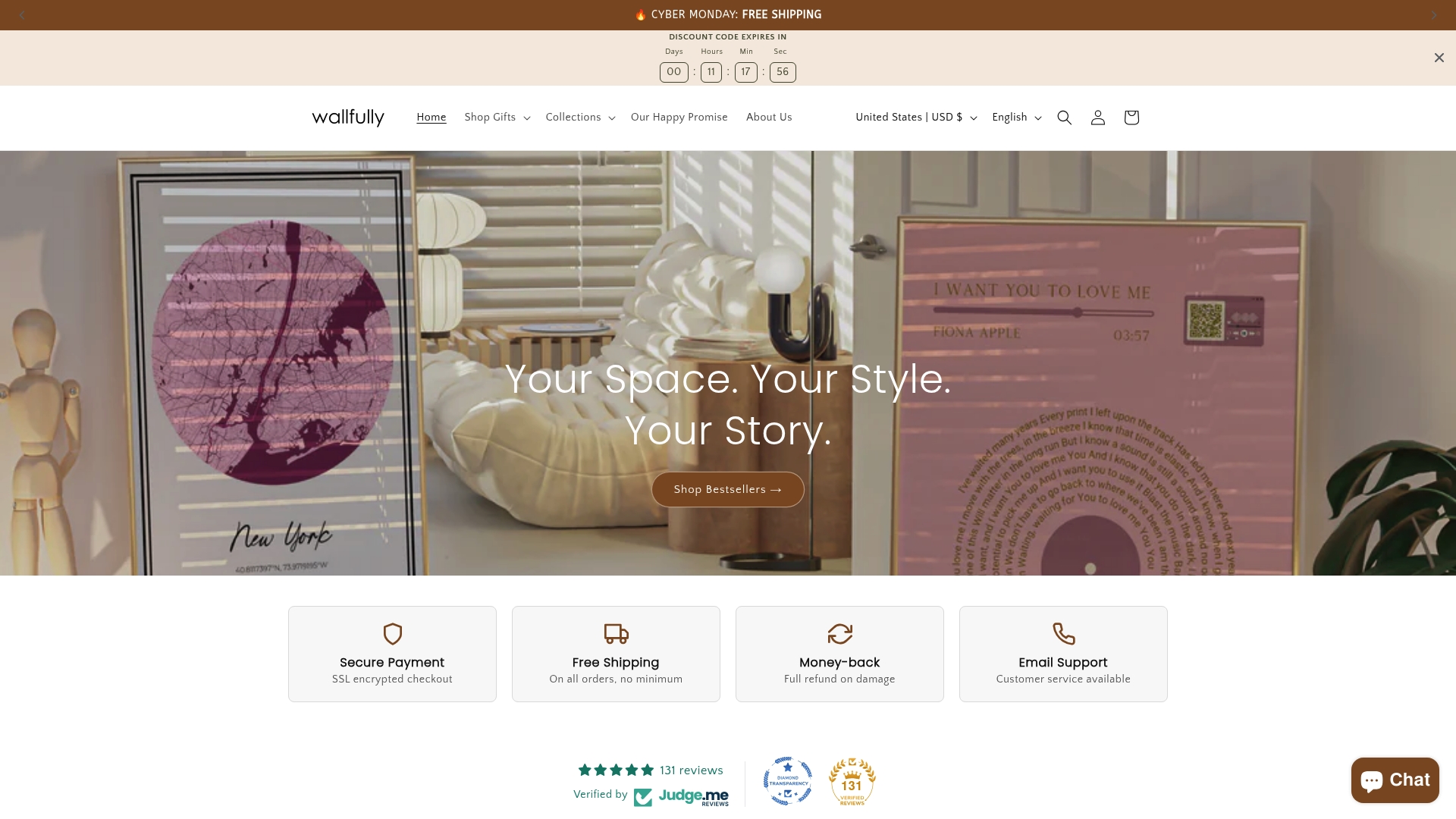
Wallfully offers free shipping on every order with no minimum spend required, so the price you see is the price you pay. Every piece is printed on eco-friendly materials and ships directly to your door in the USA, UK, Australia, and across Europe. Whether you are ordering a custom song lyric poster or a personalized map print for a gift, there are no threshold games or surprise delivery fees at checkout. Wallfully’s satisfaction guarantee means your purchase is protected from the moment you place your order. Browse the full collection and create something meaningful without worrying about the fine print.
FAQ
Is free shipping actually free for shoppers?
Free shipping means no separate delivery fee at checkout, but costs are redistributed through higher item prices, minimum spend thresholds, or subscription fees. The delivery cost exists; it is just presented differently.
How does a free shipping threshold work?
A threshold requires your cart to reach a set value before delivery becomes free. Thresholds can be calculated on pre-discount or post-discount totals, so applying a coupon code can sometimes remove your free shipping qualification.
Why do I spend more when free shipping is offered?
The goal gradient effect causes shoppers to add items to reach a free shipping threshold, often spending more than the shipping fee itself. Zero-cost delivery also triggers a positive emotional response that makes purchase completion feel more rewarding.
Does free shipping affect delivery speed?
Free shipping almost always applies to standard delivery only. Expedited or same-day shipping is typically excluded from free shipping offers and charged separately, regardless of cart value.
Are free shipping rules different in the UK compared to the USA?
Yes. UK CMA guidelines require full delivery costs in running totals until a threshold is met, giving shoppers a transparent view of what they owe. US retailers face no equivalent federal mandate, so delivery fees are often revealed only at the final checkout step.