
12 Print Ready Pet Collage Ideas You Can Build in 15 Minutes
WallfullyWant a printable pet collage in under 15 minutes? Pick one of the ideas below and build it around a single anchor photo. That’s the fastest route to something that looks intentional instead of cluttered, whether it’s headed for a frame, a card, or a memorial wall. The rest comes down to picking the right photo count, keeping the palette simple, and exporting at a resolution that survives actual printing.
TL;DR:
- A strong anchor photo, supported by 5 to 12 varied images, creates a focused and balanced collage suitable for printing or digital sharing.
- Limit backgrounds to warm tones like cream or sage and add spacing, borders, or rounded corners to elevate the design for framing.
- Use collage templates or wizard tools to arrange photos at 300 DPI in PNG or PDF format, and order a test print before committing to a final piece.
- For memorials, opt for 5 to 9 quiet, honest photos on neutral backgrounds with minimal text to evoke a calm, respectful tribute.
- Digital collages are quick and accessible for casual sharing, but printed versions last longer and make more meaningful keepsakes, especially for milestones or memorials.
Table of Contents
- 12 Pet Collage Ideas You Can Build Today
- How to Choose and Curate the Photos: A Quick Checklist
- Layout, Color, and Styling for a Print-Ready Result
- Tools, Templates, and Export Settings That Actually Print Well
- Turning the Collage Into an Actual Printed Keepsake
- Digital vs. Physical: Which One Actually Fits Your Pet Collage
- Working Pet Memorabilia Into the Collage
- The Actual Steps, Start to Finish
- Beyond the Grid: Storytelling Ideas Worth Trying
- Author Perspective: Why Curated Collages Matter
- Make Your Collage Into Something You’ll Actually Hang
- Sources
- FAQ
12 Pet Collage Ideas You Can Build Today
Every idea below works differently depending on photo count and layout. Some are built for framed wall art, others are quick enough for a phone screen or a birthday card. Use the notes to match the idea to your occasion before you start dragging photos around.
1. The Classic Grid Six to nine same-size squares, evenly spaced. Works for any pet, any personality. Printable-ready and forgiving of mismatched lighting since the uniform grid disguises it.
2. Anchor Portrait Spotlight One large hero shot takes up roughly a third of the canvas, with four to six smaller supporting images arranged around it. Best for wall art where you want a focal point rather than a wall of equal squares.
3. Memorial Tribute Layout Five to nine quiet, honest photos on a soft neutral background, minimal or no text. This is the layout for saying goodbye, not showing off. Memorial-specific templates lean hard into restraint for exactly this reason.
4. Birthday Montage Eight to ten photos spanning the pet’s life, sometimes arranged chronologically with a bold number or date overlay. Great for cards and social posts, less common as permanent wall art.
5. Multi-Pet Family Board One row or column per pet, four to six photos each, so nobody’s face gets lost in a jumble. Ideal for households with more than one animal who each deserve equal billing.
6. Action-Motion Strip Three to five sequential shots of the same movement (a jump, a zoom around the yard, a tail mid-wag). Reads almost like a flip-book. Works better digitally or as a narrow print than a square grid.
7. Adoption Timeline Six to ten photos moving from “day one” to “now,” often with small captions. Sentimental and printable, especially popular as a rescue-anniversary gift.
8. Thematic Color Moodboard Photos selected and lightly edited to share one dominant tone, sage, blush, or warm cream, rather than a specific event. Best suited to wall art since the cohesion is the whole point.
9. Minimal Single-Photo Plus Details One photo, generous white space, and a name, birthdate, or a short phrase. Not technically a “collage” in the traditional sense, but it belongs on this list because it’s the easiest printable option when you only have one great shot.
10. Sticker-Story Strip Three or four photos interspersed with small icons like paw prints or bones. Fun for digital sharing; skip the stickers if you’re printing large, since they can look busy at scale.
11. Seasonal or Holiday Pet Poster Photos from one season, framed with subtle seasonal color cues instead of literal decorations. Printable and gift-friendly around the holidays.
12. Mixed-Media Hybrid Combines two or three photos with a paw print, a favorite toy illustration, or a short quote. This one bridges into the memorabilia section below, and it’s usually the most personal option on this list.
How to Choose and Curate the Photos: A Quick Checklist
Start with a pile of 20 to 30 candidate photos, then cut hard. Most collages land best with somewhere between five and 12 final images. Fewer than five can look sparse; more than a dozen shrinks each photo until none of them register, according to design guidance on building a memorable photo collage. Memorial pieces should stay even leaner, with a moderate number of photos that keeps the layout respectful and uncluttered.
- Pick your single strongest photo first. That becomes the anchor image, the one that gets the most visual weight, with everything else arranged to support it.
- Balance the anchor with variety: one close-up, one full-body shot, one candid action moment, one texture or detail shot (a paw, a favorite collar).
- Cut near-duplicates ruthlessly. Two almost-identical photos of the same nap rarely both earn a spot.
- Crop tight enough that the pet, not the background clutter, is the subject.
- Adjust exposure and white balance so the photos don’t fight each other in tone.
- For memorials specifically, favor a neutral backdrop and skip busy text or heavy graphics.
Pro Tip: If you can’t explain in one sentence why a photo matters, cut it. That single rule does more to fix a chaotic collage than any editing tool.
Layout, Color, and Styling for a Print-Ready Result
Grid layouts suit pets with a strong, consistent look across photos. Freestyle, overlapping layouts suit pets with more visual variety, think a scruffy rescue dog whose fur color shifts between summer and winter coats. Low-cell layouts, four to six slots at most, work best for memorials where restraint matters more than density.
- Pick a limited color palette rather than letting every photo’s background compete for attention.
- Skip pure white backgrounds. Warmer tints like cream, sage, or blush tend to make fur tones pop instead of washing them out, per collage design recommendations.
- Add breathing room between photos, rounded corners soften a busy grid, and a thin border or mat helps the piece read as intentional once framed.
- A calm golden retriever suits cream and sage. A high-energy terrier can carry a bolder blush or warm mustard without looking chaotic.
Tools, Templates, and Export Settings That Actually Print Well
Four broad categories cover most needs: template galleries for a fast, pre-built layout, dedicated collage wizards that walk you through upload and arrangement, smartphone apps for quick digital shares, and desktop editors when you want finer control over spacing and color.
- A typical workflow, upload your photos, choose a layout through a collage wizard, customize spacing and text, then export, applies across most pet photo collage tools.
- For printing, export at 300 DPI as a PNG or a print-ready PDF. Anything lower and edges start looking soft once enlarged.
- Templates get you to a finished piece fast; freestyle layouts take longer but suit a one-of-a-kind wall piece better.
- Order a small test print before committing to a large framed version. It’s the cheapest insurance against a blurry surprise.
Turning the Collage Into an Actual Printed Keepsake
The design only matters once it survives printing. A square format like 8x8 or 12x12 balances evenly across grid layouts, an 8x10 suits a single hero portrait, and 16x20 makes sense when the collage is meant to anchor a wall on its own.
- Matte finish suits memorial pieces; satin brings out more life in playful, colorful collages.
- Archival paper matters if the piece is meant to last decades, not just survive one move.
- A float frame or simple mat elevates a photo grid from “printed at home” to genuine wall art.
- Before ordering anywhere, check for a design preview, confirmed print resolution, a clear returns policy, and eco-friendly materials.
Wallfully’s personalized wall art ideas walk through exactly this kind of layout-to-frame decision, and every order ships with a preview step before printing.
Digital vs. Physical: Which One Actually Fits Your Pet Collage
A digital collage costs nothing and takes minutes. Post it, text it to family, set it as a phone background, done. That instant gratification is the whole appeal, and it’s the right call for a birthday montage or a quick multi-pet update nobody needs to hang on a wall.
Physical collages ask more of you. You have to pick a print size, choose paper and finish, and wait for shipping. But a printed piece does something a phone screen never will: it sits on a wall for years, gets noticed by houseguests, and survives the day your phone gets replaced and that photo folder gets buried under thousands of new ones.
Memorial collages make the tradeoff obvious. A digital tribute is fine for sharing in the moment, but a printed, framed version becomes something to actually look at during a hard week, not something scrolled past. The reverse is true for a themed birthday board, where the photos will feel dated within a year anyway.
The practical answer: use digital for anything time-sensitive or casual, and reserve a physical print for photos with staying power, your anchor image, a memorial tribute, or a milestone collage you’d genuinely want on a wall five years from now.
Working Pet Memorabilia Into the Collage
Photos aren’t the only material worth including. A paw print cast, a small photo of a favorite collar or tag, a scan of an adoption certificate, or even a hand-drawn sketch of the pet can sit alongside photographs without cluttering the piece.
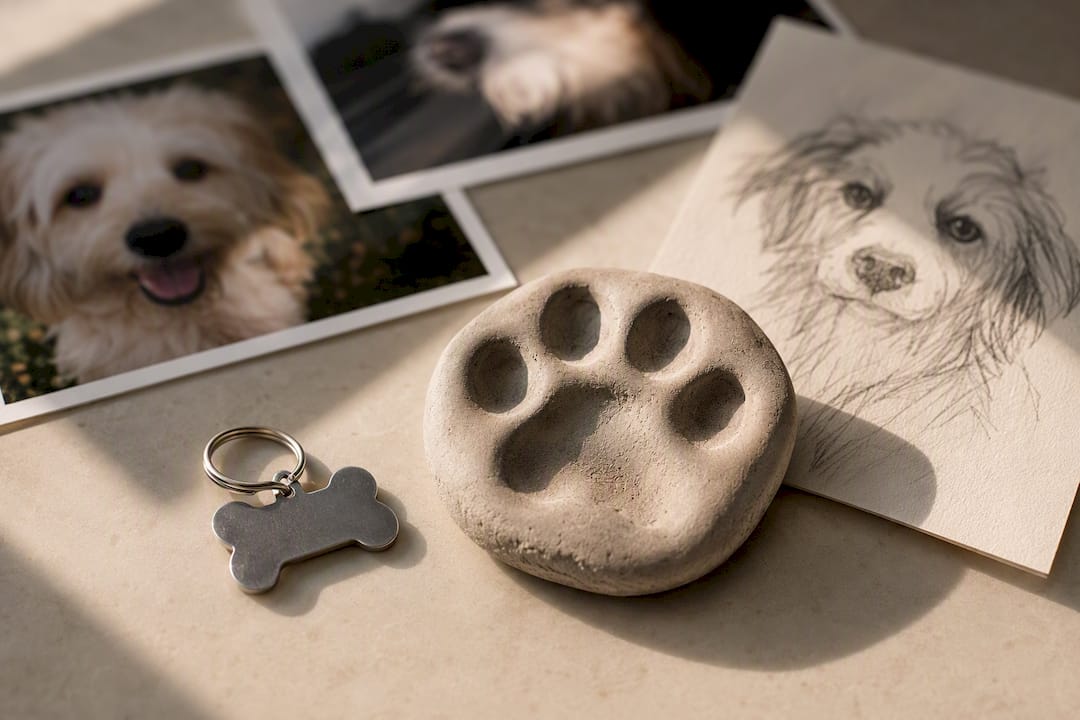
The trick is treating memorabilia the same way you treat photos: sparingly. One or two non-photo elements, placed with the same spacing and restraint as an anchor image, read as thoughtful. Five scattered mementos read as busy. A paw print works well in a bottom corner as a quiet signature element rather than competing for center attention.
For text, keep it minimal. A name and a date range, or a single short phrase, does more than a paragraph of tribute copy ever will. If you’re combining a photo of a collar tag with a live photo, crop the tag tight and desaturate it slightly so it doesn’t visually compete with the main portrait’s color.
This kind of mixed-media approach works especially well for memorial pieces and adoption-anniversary gifts, where the story is bigger than any single photo can carry alone.
The Actual Steps, Start to Finish
Gather 20 to 30 candidate photos first, before opening any design tool. Sorting comes easier with options in front of you than trying to remember what’s buried in your camera roll.
Cut that pile down to your final 5 to 12 photos using the anchor-image method: pick the strongest shot, then choose supporting images for variety rather than repetition. Open a template or collage wizard and drop your anchor photo into the largest slot first. Everything else gets arranged around it.
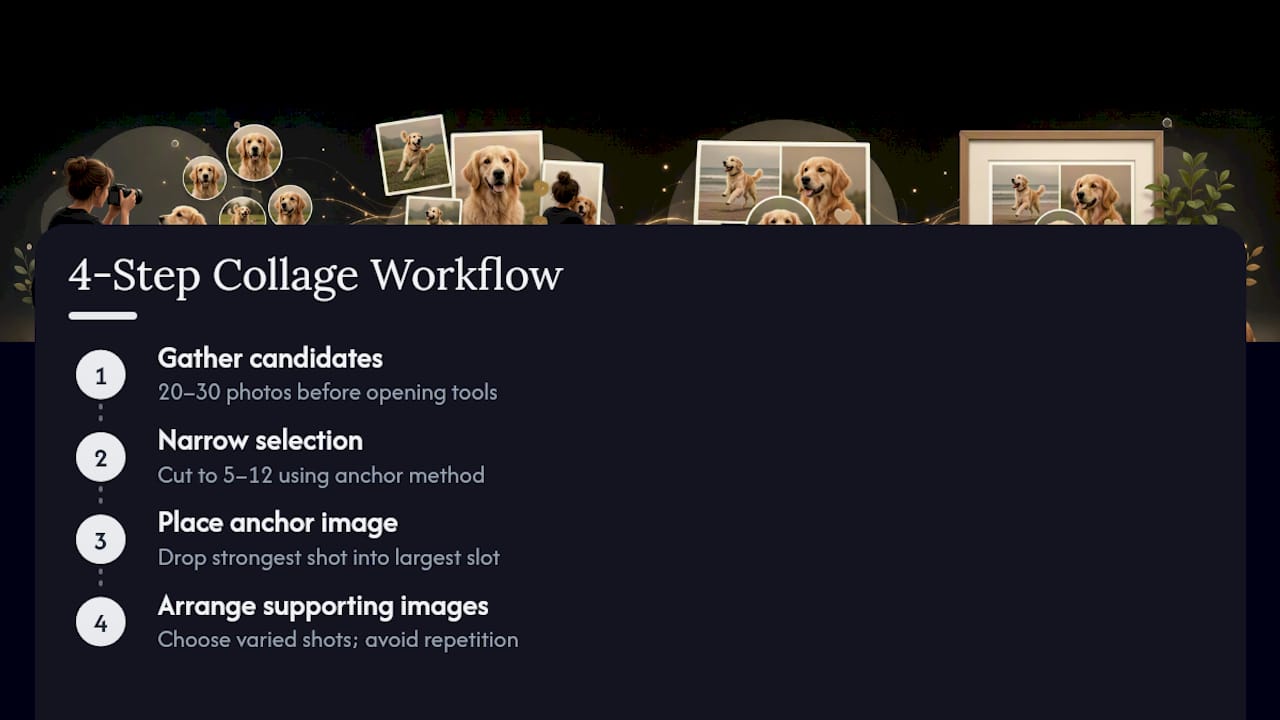
Apply light, consistent edits, slightly warmer tones, matched exposure, across all photos so they read as one piece rather than a scrapbook. Add any text or memorabilia elements sparingly, then step back and check the whole composition at a distance, not just zoomed in.
Export at 300 DPI as a PNG or print-ready PDF once the layout feels balanced. If you’re printing large, order a small test print first to catch color or crop issues before committing to a framed piece.
Beyond the Grid: Storytelling Ideas Worth Trying
A collage doesn’t have to just show what a pet looks like. It can tell a story about who they were. A “day in the life” layout, morning stretch, breakfast chaos, afternoon nap, evening walk, turns an ordinary pile of photos into a narrative arc rather than a random assortment.
A “then and now” split works well for older pets or long-time rescues: puppy or kitten photos on one side, current photos on the other, connected by a thin divider instead of a hard line. It’s a simple structure that carries real emotional weight without needing any text at all.
For multi-pet households, a “personality profile” approach, one photo per pet paired with a single word that captures their character, turns a family board into something closer to a cast of characters than a generic photo dump. And for pets who’ve passed, a “favorite places” theme, the yard, the couch, the car window, tells a gentler story than a straightforward chronological memorial.
Author Perspective: Why Curated Collages Matter
Meaning beats maximalism every time. A five-photo collage with one honest anchor image outlasts a crowded 20-photo grid nobody actually looks at twice. For a gift or memorial, pick the photo that makes you pause, build around it, and order one test print this week before you talk yourself out of starting.
— Luanda
Make Your Collage Into Something You’ll Actually Hang
Once you’ve settled on a layout, the last step is turning it into a physical piece worth keeping, and that’s where most collage projects stall out on local print shop logistics. You can build your collage inside a guided customization tool with a live preview, choose your size and framing, and order prints without hunting down a print shop or guessing at DPI settings yourself. Look for services that offer eco-friendly materials and satisfaction guarantees, so a test print isn’t a financial gamble.

If you’ve already got your anchor photo picked out, that’s the hard part done. Start building your pet collage on Wallfully and see the preview before you commit to a single print.
Sources
- Tips to Turn Your Pictures into a Memorable Collage (2026)
- Design a Pet Photo Collage You Can Print or Frame | Learn BeFunky
- Pet Memorial Tribute Collage
FAQ
What are some creative collage ideas for pets?
Anchor-portrait spotlights, adoption timelines, multi-pet family boards, and “then and now” split layouts all move beyond the basic grid while staying printable.
What are some creative art ideas for pets beyond photo collages?
Paw print casts, sketch-and-photo hybrids, and collage layouts that mix a portrait with a small memorabilia element like a collar tag all work well as pet-focused wall art.
How do you collage an animal’s photos into one cohesive piece?
Pick 5 to 12 photos, choose one strong anchor image to lead the layout, then arrange supporting shots around it using a consistent color palette and even spacing.
What are some good pet collage ideas for a memorial?
Stick to 5 to 9 quiet, honest photos on a neutral background like cream or sage, with minimal or no text, so the tribute feels calm rather than busy.
Can I use a pet collage design for a printed wall art piece?
Yes. Export the finished design at 300 DPI as a PNG or PDF, and a service like Wallfully can turn that file into a framed print with a preview step before you order.