
What is limited edition wall art: a complete guide
WallfullyYou’ve probably seen prints labeled “limited edition” and wondered if they’re just overpriced posters with fancy certificates. The truth is far more nuanced. Authentic limited edition wall art represents exclusive, finite reproductions that artists carefully control for quality and scarcity. Unlike mass-produced prints flooding big-box stores, genuine limited editions carry numbered signatures, provenance documentation, and real collector value. This guide will clarify exactly what makes wall art truly limited edition, how to spot authentic pieces, and why these distinctions matter for your home décor or gift-giving decisions.
Table of Contents
- Key takeaways
- Understanding limited edition wall art: definition and key features
- Printing techniques and authentication methods that ensure quality and trust
- Nuances, edition types, and legal protections in limited edition prints
- Limited edition versus open edition wall art: value, scarcity, and suitability
- Discover unique limited edition wall art at Wallfully
- FAQ
Key Takeaways
| Point | Details |
|---|---|
| Limited edition definition | A limited edition is a finite set of reproductions that are numbered, signed by the artist, and accompanied by a Certificate of Authenticity to document edition size and provenance. |
| Edition size impact | Smaller edition sizes create greater exclusivity and typically command higher prices for collectors. |
| Authentication features | A genuine limited edition includes a clear edition number, artist signature, COA, and proven provenance to verify legitimacy. |
| Giclee longevity | Giclee prints use archival inks on acid free media to deliver accurate color and long lasting quality. |
| Open editions contrast | Open editions are unlimited and often unsigned, generally carrying lower value than true limited editions. |
Understanding limited edition wall art: definition and key features
A limited edition print is a reproduction created from an original artwork in a strictly controlled, finite quantity. Each print receives a unique number indicating its position within the total edition, such as 15/100, meaning the fifteenth print in a run of one hundred. The artist signs each piece, typically in pencil below the image, and includes a Certificate of Authenticity documenting the edition details.
Edition sizes vary based on the artist’s intent and market positioning. Common ranges include 25, 50, 100, or 250 prints. Smaller editions create greater exclusivity and often command higher prices. An edition of 10 prints feels dramatically more scarce than one of 500, making lower-numbered editions particularly desirable to collectors. The first prints in a series, numbered 1/100 or 2/100, sometimes carry premium value simply because collectors prize early numbers.
Artists number and sign prints for several crucial reasons. The signature verifies the artist approved this specific reproduction, ensuring it meets their quality standards. Numbering creates transparency about scarcity, so buyers know exactly how many copies exist. This system prevents artists from secretly printing additional copies after claiming an edition is “limited.” Once all numbered prints sell, ethical practice dictates no reprints occur, preserving the edition’s integrity and value.
The Certificate of Authenticity serves as the print’s passport. It typically includes the artwork title, medium, paper type, edition size, print number, artist signature, and production date. Some COAs feature embossed seals or watermarks to prevent forgery. This documentation becomes essential if you ever sell the piece, as buyers require proof of authenticity. Keep your COA in a safe place separate from the print itself.
Key features distinguishing limited editions:
- Fixed production quantity announced before printing begins
- Sequential numbering showing position within total edition
- Artist’s hand-signature in pencil or archival ink
- Certificate of Authenticity with edition details
- High-quality archival materials ensuring longevity
- No reprints after edition sells out
Exploring modern wall art options helps you understand how limited editions fit within broader décor trends and personal style preferences.
Printing techniques and authentication methods that ensure quality and trust
Production quality separates genuine limited editions from cheap reproductions. Giclée printing uses archival pigment inks sprayed onto acid-free cotton or alpha-cellulose paper through microscopic nozzles. This method produces exceptional color accuracy and detail resolution, with prints lasting 100+ years under proper conditions. Other techniques include lithography, where images transfer from stone or metal plates, screen printing with layered inks, and etching with acid-etched metal plates.

The artist maintains oversight throughout production to ensure each print matches their vision. They approve color proofs, check registration accuracy, and verify paper quality before signing off on the edition. This involvement guarantees fidelity to the original artwork’s colors, contrast, and subtle details. Without artist supervision, prints can drift toward inaccurate color casts or lose fine detail, diminishing their value.
Hand-signatures provide crucial authentication. Artists typically sign in pencil because it creates variable pressure marks impossible to replicate with stamps or digital printing. A genuine pencil signature shows slight inconsistencies between prints, proving each was individually signed. Some artists use archival pens, but pencil remains the gold standard. The signature usually appears in the lower right corner, with the edition number in the lower left and title centered below the image.
Certificates of Authenticity contain specific information verifying legitimacy. Expect to see the artwork title, artist name, edition size including any Artist’s Proofs, your print’s unique number, printing method, paper specifications, and production date. Many COAs include the artist’s signature and contact information for verification. High-value prints may feature holographic seals, embossed stamps, or unique serial numbers linking the certificate to the specific print.
Embossing adds a tactile authentication layer. A small raised seal, often called a chop mark, gets pressed into the paper’s margin. This seal might contain the artist’s initials, studio logo, or edition information. Because embossing requires specialized equipment and damages the paper if removed, it’s difficult to forge. Run your fingers over the margin to feel for these raised marks.
Provenance documentation tracks ownership history from creation through each subsequent sale. This paper trail becomes increasingly important as prints change hands. Gallery receipts, auction records, and previous owner documentation establish an unbroken chain proving authenticity. Strong provenance significantly boosts resale value because buyers gain confidence in the print’s legitimacy.
Pro Tip: Photograph your limited edition print next to its COA and any embossing marks immediately after purchase. Store these images with your insurance documents. If the print is ever stolen or damaged, this visual evidence helps with claims and recovery.
Mastering your wall art shopping workflow ensures you make informed decisions about quality, authenticity, and value when selecting pieces for your collection.
Nuances, edition types, and legal protections in limited edition prints
Not all limited edition prints are created equal. Artist’s Proofs, marked “AP” or “A/P,” represent test prints created before the main edition. Artists traditionally kept these proofs to evaluate quality, but they’re now sold separately. APs typically comprise 10% of the total edition size. An edition of 100 might include 10 Artist’s Proofs, making the complete run 110 prints. Because APs are rarer than standard numbered prints, collectors sometimes pay premiums for them.
Hors Commerce prints, marked “HC,” translate to “not for commerce” in French. These were originally reserved for the artist’s personal collection, gifts to collaborators, or gallery display copies. Like APs, HCs exist outside the main numbered edition. An edition might consist of 50 numbered prints, 5 APs, and 3 HCs, totaling 58 pieces. Understanding these distinctions matters because the actual scarcity differs from the advertised edition number.
Legal regulations protect buyers in some jurisdictions. Laws in France and California require artists and galleries to disclose complete edition information, including all proofs and HCs. These laws prevent deceptive practices where sellers advertise a “limited edition of 50” while secretly producing 20 additional unnumbered copies. When buying high-value prints, ask for full disclosure of total production numbers.
Edition size dramatically impacts value and collectibility. A print numbered 5/25 carries more cachet than 150/500, even if both are technically limited editions. Smaller editions create genuine scarcity, which drives collector interest and resale potential. Artists building reputations often start with larger editions (200-500) to reach more buyers, then reduce edition sizes as demand grows. Established artists might release editions of just 10-50 prints, knowing scarcity will drive prices higher.
| Edition type | Typical quantity | Purpose | Market value |
|---|---|---|---|
| Standard numbered | 25-250 prints | Primary sales to collectors | Base edition price |
| Artist’s Proofs (AP) | ~10% of edition | Quality testing, artist retention | 10-25% premium |
| Hors Commerce (HC) | 2-10 prints | Artist personal use, gifts | Similar to AP pricing |
| Trial proofs | 1-5 prints | Pre-production testing | Highest premium if sold |
Ethical practices prohibit reprinting editions after they sell out. Once print 100/100 sells, the artist should never create print 101. This commitment to finite production underpins the entire limited edition concept. Unfortunately, some unscrupulous sellers create new “editions” with slight variations, such as different paper or sizes, essentially reprinting sold-out work. Reputable artists clearly distinguish between separate editions and avoid this gray area.
Provenance becomes your protection against fraud and misrepresentation. Always request documentation showing the print’s journey from artist or authorized gallery to you. This chain of custody proves you own an authentic edition piece, not an unauthorized reproduction. When buying from secondary markets, insist on seeing original purchase receipts and any prior sale records.
Pro Tip: Before buying a limited edition print, search online for the artist’s name plus the edition number. If you find the same edition advertised years apart with different total quantities, that’s a red flag indicating the artist may have expanded the edition or created unauthorized reprints.
Exploring wall art collections personalization options shows how limited edition principles apply to customized pieces, blending exclusivity with personal meaning.
Limited edition versus open edition wall art: value, scarcity, and suitability
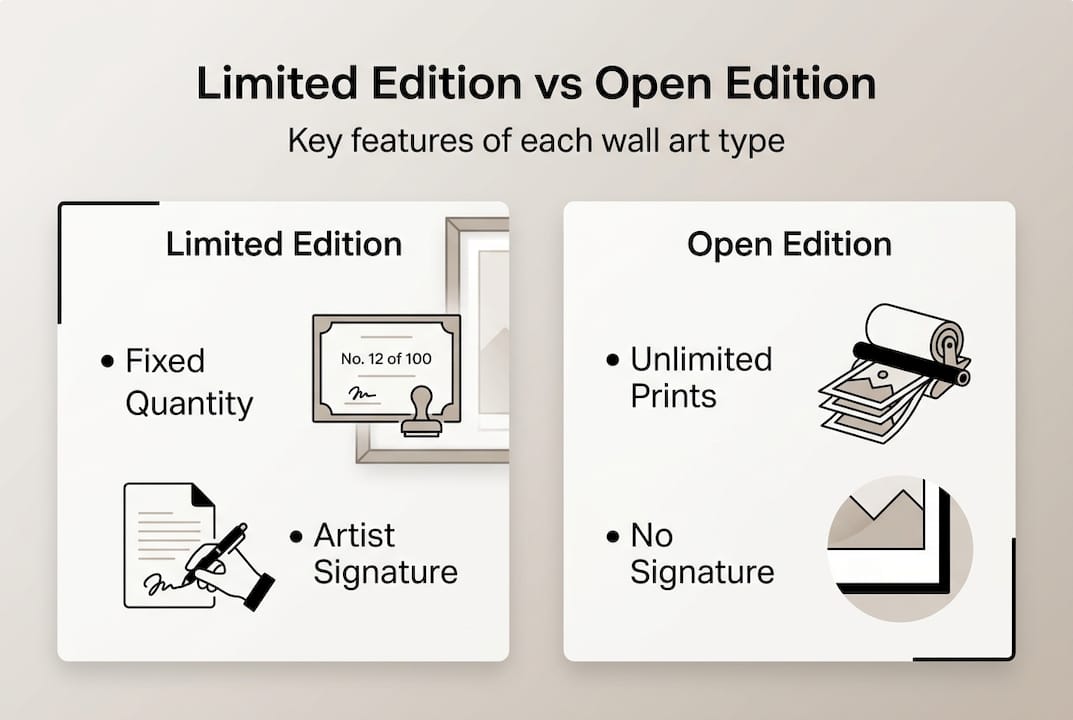
Open edition prints represent the opposite approach to limited editions. These reproductions have no production cap, no numbering, and typically no artist signature. Publishers can print additional copies whenever demand exists, whether that’s 100 copies or 100,000. You’ll find open editions at furniture stores, online poster shops, and mass retailers. They serve decorative purposes beautifully but lack the scarcity driving collector value.
Limited editions offer fixed quantities and artist signatures, creating potential for appreciation. Open editions prioritize affordability and accessibility over exclusivity. Neither approach is inherently better; they serve different audiences and purposes. Understanding these differences helps you choose appropriately for your situation.
| Feature | Limited edition | Open edition |
|---|---|---|
| Production quantity | Fixed, disclosed number | Unlimited, ongoing |
| Numbering | Yes, sequential | No |
| Artist signature | Hand-signed | Usually unsigned or printed signature |
| Certificate of Authenticity | Included | Rarely provided |
| Initial price range | $200-$10,000+ | $20-$300 |
| Resale potential | Can appreciate with artist reputation | Minimal, often depreciates |
| Best for | Collectors, investors, meaningful gifts | Casual décor, budget-conscious buyers |
Price differences reflect scarcity and artist involvement. A limited edition giclée might cost $500-$2,000, while an open edition poster of similar size runs $50-$150. You’re paying for exclusivity, archival quality, and the artist’s direct participation. Limited editions use premium materials designed to last generations, whereas open editions often use standard paper and inks that fade within decades.
Resale value tells the real story. Limited editions from recognized artists can appreciate significantly, especially as edition numbers dwindle through damage, loss, or collectors holding pieces long-term. An edition that sold for $800 initially might fetch $2,000-$5,000 years later if the artist gains prominence. Open editions rarely increase in value because anyone can buy a fresh copy at retail price indefinitely.
Collectors and serious art enthusiasts gravitate toward limited editions for several reasons:
- Genuine scarcity creates investment potential
- Artist signatures provide direct connection to creator
- Archival materials ensure longevity
- Exclusivity offers bragging rights and uniqueness
- Provenance documentation supports authenticity
Casual decorators and budget-conscious buyers find open editions perfectly suitable. If you love an image and want it on your wall without concern for resale value, open editions deliver excellent results at accessible prices. Many people rotate their wall art every few years as tastes change, making the permanence of limited editions unnecessary.
Gift-giving scenarios require careful consideration. A limited edition print makes an extraordinary present for milestone occasions like weddings, anniversaries, or major achievements. The exclusivity and artist signature communicate thoughtfulness and significance. For casual gifts or recipients who frequently redecorate, open editions provide beautiful options without the investment pressure.
Your decision should align with your goals. Ask yourself: Am I building a collection with potential appreciation? Do I want something truly unique? Will this piece stay in my home for decades? If you answered yes to these questions, limited editions justify their premium. If you’re decorating temporarily or prioritizing affordability, open editions serve you well.
Browsing minimalist wall art ideas demonstrates how both limited and open editions can enhance your space when chosen thoughtfully for your specific aesthetic goals.
Discover unique limited edition wall art at Wallfully
Now that you understand what makes wall art truly limited edition, you’re ready to explore authentic options for your home or gift-giving needs. Wallfully specializes in curated collections that blend exclusivity with personalization, offering pieces that carry genuine meaning beyond mass-produced décor. Whether you’re seeking milestone prints, custom maps, or personalized designs, each piece receives careful attention to quality and authenticity.

Our platform guides you through customization options that make each print uniquely yours while maintaining the quality standards you’d expect from limited edition work. Explore collections designed for art enthusiasts who value both aesthetic appeal and personal significance. Visit Wallfully to discover how personalized wall art can transform your space with pieces as individual as your story.
FAQ
Is limited edition wall art a good investment?
Limited editions can appreciate in value, particularly when the artist gains recognition and the edition size remains small. Scarcity drives collector demand, so prints numbered within smaller editions (under 50) from emerging artists offer the strongest appreciation potential. Provenance documentation and condition significantly affect resale value, making proper care and storage essential for maintaining investment quality.
How can I verify the authenticity of limited edition prints?
Examine the hand-signature for variable pencil pressure that proves individual signing rather than mechanical reproduction. Request the Certificate of Authenticity and verify it includes complete edition information, printing method, and paper specifications. Check for embossing marks in the margins and research the gallery or seller’s reputation. Reputable sources provide provenance documentation tracing the print’s ownership history from creation to current sale.
What are the best ways to display and preserve limited edition wall art?
Use UV-protective glass or acrylic when framing to prevent light damage and fading. Ensure acid-free matting and backing materials that won’t yellow or deteriorate the print over time. Avoid hanging in direct sunlight, near heating vents, or in high-humidity areas like bathrooms. Climate-controlled environments between 65-75°F with 40-50% humidity provide optimal preservation conditions for archival prints lasting generations.
Can limited edition wall art be personalized as gifts?
Some artists and platforms offer limited edition prints with customization options like added names, dates, or location details while maintaining numbered edition integrity. Small edition sizes naturally boost the gifting impact by providing genuine exclusivity your recipient won’t find elsewhere. These pieces make exceptional presents for weddings, anniversaries, or milestone celebrations where meaningful, personalized limited edition gifts communicate thoughtfulness beyond standard décor items.