

Sustainable Print Materials: A Guide for Eco-Conscious Designers
WallfullyTL;DR:
- Sustainable print materials include FSC-certified, recycled, and plant-based papers and eco-friendly inks. Digital printing reduces chemical use, waste, and energy consumption, making it ideal for short runs. Specificity in project requirements ensures environmentally responsible choices and minimizes ecological impact.
Sustainable print materials are substrates, papers, and inks chosen to minimize environmental harm across their full production lifecycle. Understanding sustainable print materials means going beyond recycled paper labels. It requires knowing how FSC certification, Post-Consumer Recycled (PCR) fiber, soy-based inks, and print-on-demand production each reduce ecological impact at different stages. Designers and eco-conscious consumers who grasp these distinctions make better choices for their projects, their budgets, and the planet. Wallfully builds this thinking directly into its printing process, using eco-friendly materials as a baseline rather than an afterthought.
What types of materials and inks are considered sustainable in printing?
Sustainable printing options span a wide range of papers, alternative substrates, and ink formulations. Each category carries different environmental trade-offs, and knowing those differences is the foundation of any responsible printing practice.

Certified and recycled papers
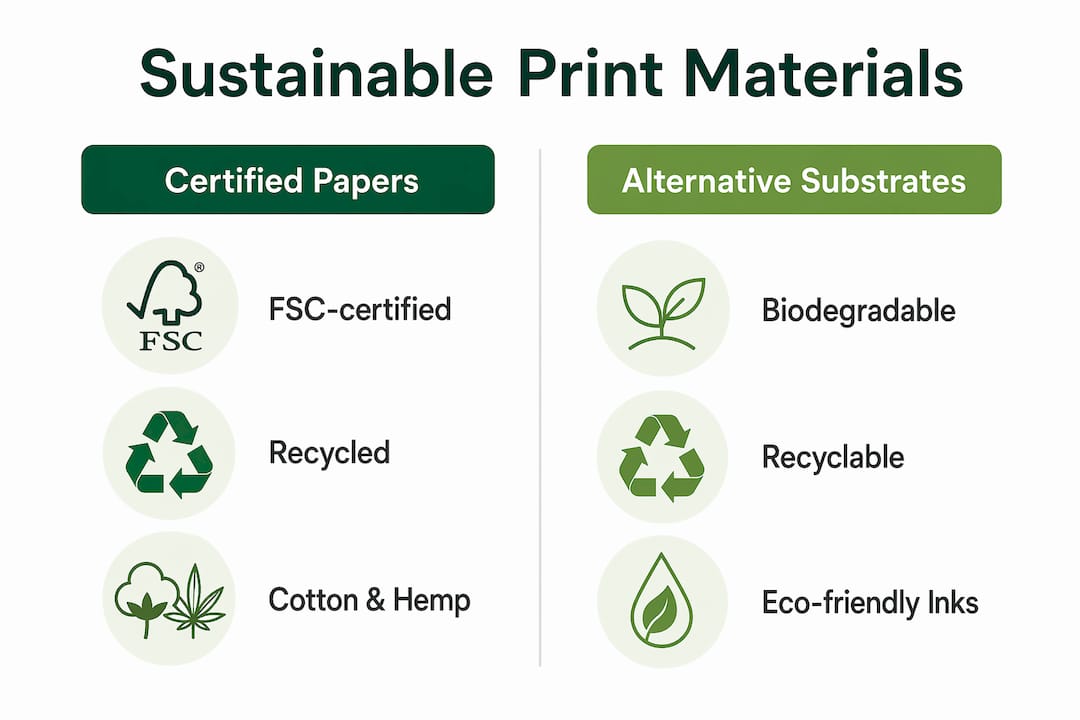
FSC-certified paper is the most recognized standard for responsible sourcing. FSC certification provides an independent chain of custody audit from forest to printer, confirming that timber comes from responsibly managed forests. Post-Consumer Recycled (PCR) paper uses fiber recovered after consumer use, diverting waste from landfills. However, recycling paper involves chemical treatment that carries its own environmental footprint. That means PCR is not automatically the greener choice in every situation.
Cotton and hemp papers offer a compelling alternative. Both are produced without wood pulp, require fewer chemicals to process, and biodegrade more readily than standard paper. Hemp in particular grows quickly with minimal pesticide use, making it one of the lower-impact fiber sources available.
Alternative substrates
PVC foam boards dominate signage and large-format printing, but they are neither recyclable nor biodegradable. Arrow Greenboard is a 100% biodegradable, PVC-free board made from recyclable paper pulp that eliminates plastic coatings and lamination entirely. Paper-based honeycomb boards serve the same structural purpose as PVC foam while remaining fully recyclable at end of life. These substrates are practical for retail displays, event signage, and framed art backing.
Eco-friendly inks
Soy and vegetable-based inks use renewable vegetable oils that reduce volatile organic compound (VOC) emissions and make de-inking easier during paper recycling. Water-based inks go further: they are non-toxic, low odor, and reduce chemical cleanup requirements significantly. Both ink types outperform petroleum-based alternatives on environmental metrics without sacrificing print quality for most applications.
- FSC-certified paper: Traceable from forest to printer with independent auditing
- PCR paper: Diverts post-consumer waste but involves chemical reprocessing
- Cotton and hemp papers: Wood-free, fast-growing, and biodegradable
- Arrow Greenboard: PVC-free, biodegradable, scratch-resistant signage substrate
- Soy and vegetable-based inks: Lower VOC emissions, easier de-inking
- Water-based inks: Non-toxic, low odor, minimal chemical cleanup
Pro Tip: Ask your printer for the specific fiber content percentage on any recycled paper. A sheet labeled “recycled” may contain as little as 10% PCR content. Specify a minimum of 50–100% PCR to guarantee meaningful environmental benefit.
How does digital printing contribute to sustainability?
Digital printing is the most practical green printing solution for short to mid-run projects. The environmental advantages over traditional offset printing are measurable and significant.
Digital printing reduces chemical usage by up to 90% compared to offset methods. Offset printing requires metal plates, chemical developers, and fountain solutions. Digital printing eliminates all of those. That reduction in chemical inputs directly lowers the toxic waste a print job generates.
Waste generation tells a similar story. Digital presses generate only 1–3% waste compared to 3–10% in offset printing. That gap widens on shorter runs, where offset setup waste represents a larger share of total material used. Energy consumption also drops: digital printing lowers energy usage by 20–60% per job depending on run size. For a designer producing 50 custom posters, digital is the clear choice on both waste and energy grounds.
Print-on-demand takes these benefits further. Print-on-demand reduces overproduction and obsolete inventory by 20–40%. Nothing gets printed until an order exists, which means no unsold stock ends up in a landfill.
| Factor | Digital printing | Offset printing |
|---|---|---|
| Chemical usage | Up to 90% lower | High (plates, developers, fountain solutions) |
| Waste generation | 1–3% per job | 3–10% per job |
| Energy usage | 20–60% lower per job | Higher, especially on short runs |
| Overproduction risk | Minimal (print-on-demand capable) | High on short runs |
| Plate production | None required | Required for every job |
Pro Tip: For runs under 500 units, digital printing almost always wins on sustainability metrics. Reserve offset for large-volume jobs where its per-unit efficiency eventually offsets the setup waste.
What nuanced factors should you consider when choosing eco-friendly print materials?
Selecting eco-friendly print materials is not a single decision. It is a series of project-specific trade-offs that depend on quality requirements, end use, and lifecycle considerations.
The recycled versus virgin fiber debate is a good example. Balancing recycled and virgin fibers avoids quality compromises and environmental trade-offs. For a high-resolution art print that needs to last decades, FSC-certified virgin fiber may actually be the more traceable and durable choice. For a short-run promotional flyer, high-PCR content paper is the better call. The right answer depends on the project, not a blanket rule.
Certifications matter beyond the paper itself. Sustainable printing is a process that includes materials, supply chain, energy sources, waste management, and social responsibility. A printer using recycled paper but running on coal power and sending chemical waste to landfill is not genuinely sustainable. Verifiable certifications and carbon balancing distinguish real eco-friendly printing from greenwashing.
Key factors to evaluate before committing to a print material or supplier:
- Project longevity: A print meant to last 20 years on a wall needs archival-quality materials. A short-run event poster does not.
- End-of-life recyclability: Laminated prints cannot be recycled. Uncoated or water-based coated papers can.
- Substrate compatibility: Some eco-friendly inks perform differently on recycled papers. Test before committing to a large run.
- Printer certifications: Look for FSC chain-of-custody certification, ISO 14001 environmental management, and zero-to-landfill waste policies.
- Carbon mitigation: Ask whether your printer offers carbon balancing or offsets for unavoidable emissions.
- Volume: Low-volume projects benefit most from digital printing. High-volume projects may justify offset if the per-unit environmental math works out.
The end-of-life question is often overlooked. A biodegradable substrate that ends up in a landfill does not biodegrade meaningfully. Choosing recyclable materials only delivers environmental benefit if the end user actually recycles them. Designers can support this by printing recycling instructions directly on packaging or signage.
How can designers and consumers apply responsible printing practices?
Practical application is where good intentions become real environmental impact. These steps move sustainable print choices from concept to execution.
-
Write a specific sustainable print brief. Vague requests for “green options” produce inconsistent results. Effective sustainable print briefs specify FSC accreditation, minimum recycled content ratios, ink type preferences, and carbon mitigation requirements. A brief that says “FSC-certified paper, minimum 50% PCR content, water-based inks, carbon-balanced production” gives a printer clear targets to meet.
-
Choose print-on-demand for custom and short-run projects. Print-on-demand eliminates overproduction entirely. For personalized wall art, custom posters, and milestone prints, it is the most direct way to avoid waste. Wallfully uses a print-on-demand model that prints each piece only after an order is placed, cutting excess inventory to zero.
-
Verify your printer’s full supply chain. Ask about energy sources, waste disposal practices, and whether the facility holds ISO 14001 certification. A printer that uses recycled paper but ships internationally with no carbon offset is not delivering the environmental benefit you expect.
-
Select substrates based on end use. For wall art and framed prints, uncoated FSC-certified paper or cotton rag paper delivers quality and recyclability. For signage and displays, paper-based boards like Arrow Greenboard replace PVC without sacrificing durability. For packaging, recycled kraft board with water-based inks is the standard responsible choice.
-
Plan for end-of-life from the start. Avoid lamination where possible. Laminated prints cannot enter standard paper recycling streams. If a protective coating is necessary, specify a water-based varnish instead. This keeps the substrate recyclable and reduces chemical inputs.
-
Evaluate sustainable printing techniques for your specific project type. Different methods suit different scales and materials. Knowing which technique aligns with your sustainability goals saves both time and resources.
Products with unique, high-quality packaging are 30% more likely to attract new customers. Sustainable packaging is not a compromise on appeal. It is a competitive advantage for brands that want to connect with eco-conscious buyers.
Key takeaways
Sustainable print materials deliver real environmental benefits only when material choice, printing method, and supply chain verification work together across the full project lifecycle.
| Point | Details |
|---|---|
| FSC certification is the baseline | Specify FSC-certified paper and chain-of-custody auditing in every print brief. |
| Digital printing cuts waste and chemicals | Digital presses generate 1–3% waste versus 3–10% for offset, and use up to 90% fewer chemicals. |
| Recycled does not always mean better | PCR paper involves chemical reprocessing; FSC-certified virgin fiber can be more traceable for long-life prints. |
| Print-on-demand eliminates overproduction | Printing only to order reduces obsolete inventory by 20–40% and removes landfill risk. |
| Verify the full supply chain | Eco-friendly materials paired with coal power and landfill waste disposal do not add up to sustainable printing. |
Why specificity is the real skill in sustainable printing
Most designers I talk to approach sustainable printing the same way: they ask for recycled paper and call it done. That instinct is understandable, but it misses most of the environmental impact. The paper is often the smallest variable. Energy source, chemical waste, transportation, and end-of-life handling collectively matter more.
The shift that actually changes outcomes is specificity. When you write a print brief that names FSC accreditation, a minimum PCR percentage, ink type, and carbon balancing, you are giving your printer a real target. Vague requests produce vague results. Specific briefs produce verifiable ones.
The recycled-versus-virgin debate taught me something counterintuitive early on. A piece of wall art meant to hang for 20 years needs archival paper that holds color and resists yellowing. High-PCR content paper often cannot meet that standard. FSC-certified virgin fiber from a traceable, responsibly managed forest is the better environmental and quality choice in that context. Sustainability is not a single axis. It is a set of trade-offs you navigate per project.
Digital printing changed the math for short runs entirely. The ability to print a single custom poster without plate setup, chemical developers, or excess inventory is genuinely transformative for small-scale and personalized work. Wallfully’s eco-friendly wall art process reflects exactly this thinking: print only what is ordered, use materials with verified credentials, and keep the supply chain as short as possible.
The last thing I would push any designer or eco-conscious consumer to do is audit their printer’s certifications directly. Not just the paper spec sheet. Ask about ISO 14001 status, waste disposal contracts, and energy sourcing. The answers will tell you more about a printer’s actual environmental impact than any marketing claim on their website.
— Luanda
Wallfully’s approach to eco-friendly printing
Wallfully prints every piece to order using eco-friendly materials, which means no overproduction and no unsold stock heading to a landfill. Every custom poster, song lyric print, and milestone piece is produced only when you place an order.

Designers and eco-conscious consumers who want personalized wall art without the environmental cost of mass production will find Wallfully’s model worth exploring. The platform uses verified sustainable materials and a print-on-demand process that keeps waste minimal from start to finish. Browse the full range of custom wall art at Wallfully to see how responsible printing practices translate into pieces worth keeping for years.
FAQ
What does FSC certification mean for print materials?
FSC certification confirms that paper comes from responsibly managed forests with an independent chain of custody audit from forest to printer. It is the most widely recognized standard for environmental, social, and economic forestry management.
Is recycled paper always the most sustainable choice?
Not always. Recycling paper involves chemical treatment that carries its own environmental footprint. FSC-certified virgin fiber from a traceable sustainable forest can be the better choice for long-life prints that require archival quality.
How does print-on-demand reduce environmental impact?
Print-on-demand eliminates overproduction by printing only when an order is placed. This reduces obsolete inventory by 20–40% and removes the landfill risk associated with unsold stock.
What are soy-based inks and why do they matter?
Soy-based inks use renewable vegetable oils instead of petroleum, which lowers VOC emissions and makes de-inking easier when paper enters the recycling stream. They are a direct substitute for conventional inks in most printing applications.
What should a sustainable print brief include?
A specific sustainable print brief names FSC accreditation, minimum recycled content ratios, ink type (soy-based or water-based), and carbon mitigation requirements. Specific briefs produce verifiable results; vague requests for “green options” do not.