
What Is Archival Quality Printing and Why It Matters
WallfullyTL;DR:
- Archival quality printing produces long-lasting prints using pigment-based inks, acid-free substrates, and calibrated printers. Proper framing with UV protection and careful display conditions are essential to maintain the print’s longevity. Many buyers overlook the importance of framing and material standards, risking significant deterioration over time.
Archival quality printing is defined as the process of producing prints that maintain their original color, clarity, and physical integrity for decades or centuries under proper care. The industry term for the most recognized form is giclée printing, though archival standards apply across multiple methods. True archival prints require pigment-based inks, acid-free substrates, advanced multi-color inkjet systems, and strict color management. Understanding these components tells you exactly why a wedding photo printed at a drugstore looks faded in five years while a fine art print from a reputable lab still looks sharp in fifty.
What is archival quality printing made of?
A true archival print depends on four technical pillars: ink chemistry, substrate composition, printer capability, and color management. Miss any one of them and the print does not qualify as archival, regardless of what the label says.
Ink: pigment vs. dye
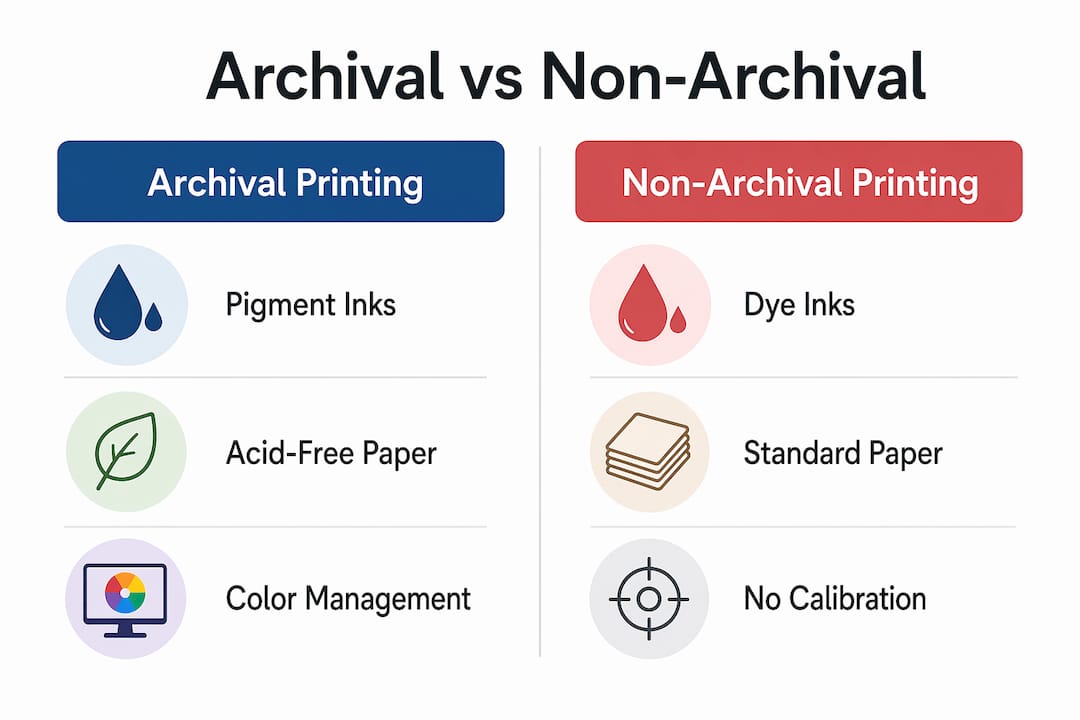
Pigment-based inks are the foundation of every professional archival print. Dye-based inks dissolve into the paper fiber and fade significantly faster when exposed to light, humidity, or air pollutants. Pigment inks sit on top of the substrate in microscopic particles that resist chemical breakdown far longer. Only pigment inks meet professional archival standards.
Substrates: what the ink lands on
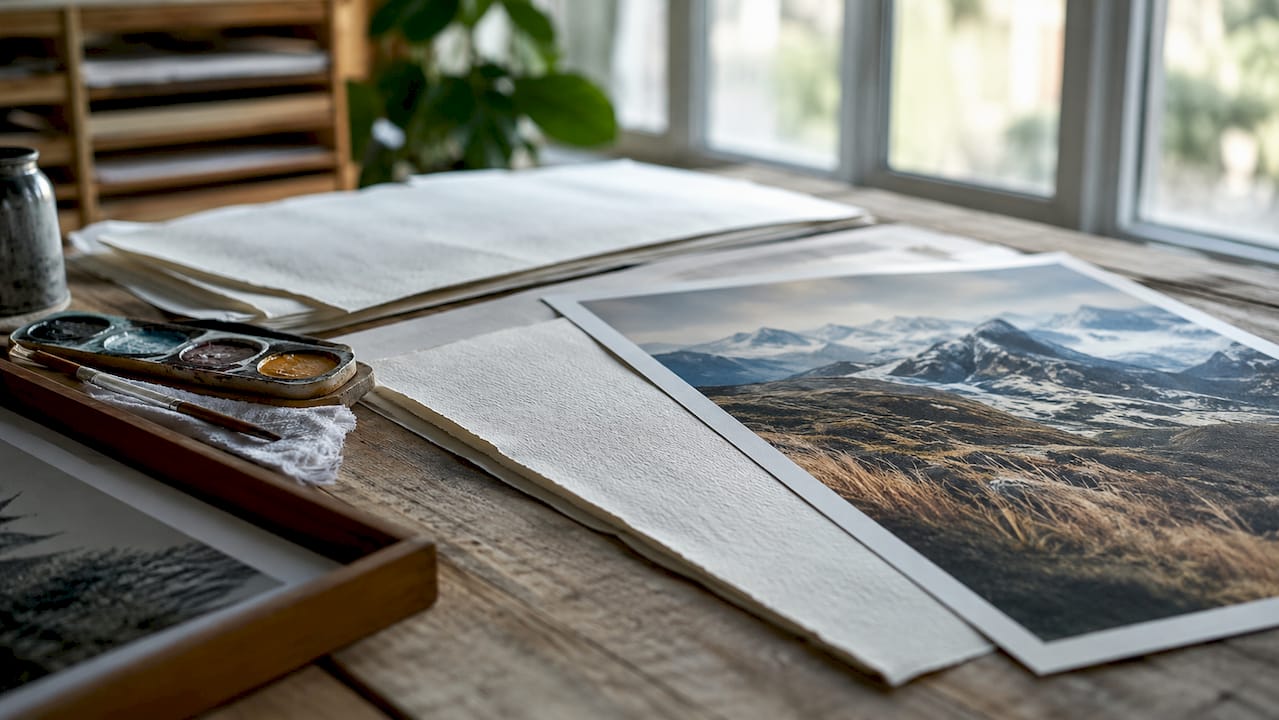
The paper or material beneath the ink matters as much as the ink itself. Archival substrates like 100% cotton rag and baryta paper are acid-free and lignin-free, meaning they will not yellow or become brittle over time. Standard wood-pulp papers contain acids that break down the fiber structure within years. Certified archival substrates often reach 96% or higher luminance, which means colors appear vivid and true without the warm cast that cheaper papers introduce. Baryta paper, originally developed for darkroom silver halide printing, is now widely used in inkjet archival work because it replicates the deep blacks and fine detail of traditional photographic paper.
Pro Tip: When ordering prints for long-term display, ask the lab specifically whether they use cotton rag or baryta paper. “Premium paper” is a marketing phrase, not an archival standard.
Printer systems and color management
Advanced inkjet systems with 8–12 color channels, such as the Epson SureColor series, can reproduce up to 99% of the Pantone color range. That range matters because standard four-color CMYK printers compress the color space, losing subtle gradients in skin tones, skies, and shadow detail. Calibrated color management software profiles each ink and paper combination to ensure the printed output matches the original file. Without calibration, even the best inks and papers produce inconsistent results.
| Component | Archival standard | Non-archival alternative |
|---|---|---|
| Ink type | Pigment-based, 8–12 color | Dye-based, 4-color CMYK |
| Substrate | Cotton rag or baryta, acid-free | Wood-pulp paper, no pH rating |
| Printer system | Epson SureColor, 8–12 channels | Standard desktop inkjet |
| Color management | ICC profile calibration | No profiling |
How do archival print methods compare?
Not every archival print method uses the same process. Three methods dominate the field: digital giclée, platinum palladium, and silver halide. Each has a distinct lifespan, production workflow, and best use case.
Digital giclée printing
Giclée printing uses high-resolution inkjet technology with pigment inks on archival substrates to produce fine art reproductions and original prints. The word giclée comes from the French verb meaning “to spray,” describing how the printer deposits microscopic ink droplets. However, not all giclée prints are archival. Some budget labs use pigment ink on non-archival papers or skip color management entirely, which cuts the lifespan dramatically. A properly produced giclée print from a certified lab is expected to last well over 100 years under controlled display conditions.
Platinum palladium printing
Platinum palladium printing is a hand-coated photographic process dating to the 1880s. The printer applies a light-sensitive platinum and palladium solution to paper by hand, exposes it to UV light through a film negative, and develops it in a chemical bath. Platinum palladium prints can last thousands of years because the image is formed from metal particles embedded in the paper fiber rather than ink sitting on the surface. The human element is also critical. Ambient humidity and brush pressure during hand-coating directly affect the final quality and longevity of each print.
Silver halide photographic printing
Silver halide printing uses light-sensitive paper processed with RA-4 chemistry, the same method used in professional photo labs for decades. Silver halide prints offer 60–200 years of stability in dark storage. They produce continuous-tone images with no visible dot pattern, which gives photographs a smooth, film-like quality that inkjet prints can approach but rarely match exactly.
| Method | Expected lifespan | Best use case |
|---|---|---|
| Digital giclée | 100+ years (certified lab) | Fine art reproductions, custom prints |
| Platinum palladium | Thousands of years | Collectible fine art, museum work |
| Silver halide | 60–200 years (dark storage) | Photography, portrait prints |
- Giclée is the most accessible and widely available archival method for custom and personalized prints.
- Platinum palladium suits collectors and artists who want the longest possible lifespan and a handmade quality.
- Silver halide works best for photographic subjects where continuous-tone rendering is the priority.
Why is archival printing important for preserving artwork?
Archival printing is an act of stewardship, creating physical objects that preserve artistic and emotional integrity for future generations. A wedding portrait, a child’s first drawing reproduced as a fine art print, or a limited-edition artwork all carry meaning that extends beyond the moment of creation. Archival methods protect that meaning by ensuring the object survives intact.
The practical benefits of archival printing are direct and measurable:
- Color stability. Pigment inks and calibrated color management prevent the color shifts that make non-archival prints look faded or yellowed within years.
- Material integrity. Acid-free substrates do not become brittle, crack, or discolor over time the way wood-pulp papers do.
- Investment protection. A print should be considered either an investment or a liability. Pigment-based inks are the dividing line between a print that holds its value and one that does not.
- Emotional preservation. Photographs of people who have passed, milestone moments, and original artwork carry irreplaceable emotional weight. Archival printing protects that weight.
- Resale and collection value. Museums and serious collectors require archival documentation before acquiring prints. A print without certified archival materials has no place in a serious collection.
Pro Tip: Ask any lab for their Wilhelm Imaging Research ratings or ISO 18902 compliance documentation before ordering. These are the recognized industry benchmarks for archival print longevity.
A common misconception is that “archival” is simply a label a lab applies to any premium product. It is not. Archival quality is a system, and every component must meet the standard for the claim to hold. You can read more about why archival quality matters for retail art prints to understand how these standards translate to real-world purchasing decisions.
What factors affect how long archival prints last?
Production quality sets the ceiling for a print’s lifespan. How you display and store the print determines whether it reaches that ceiling. Longevity results from both production choices and the owner’s care, making it a shared responsibility between the lab and the person who owns the print.
UV light is the single biggest threat to any print on display. Direct sunlight accelerates fading in even the best pigment inks. Improper framing or display in direct sunlight will degrade a fine archival print prematurely. UV-protective glazing, either museum glass or acrylic, filters out the wavelengths that cause the most damage. UV-protective glazing and acid-free backings are not optional upgrades for archival work. They are part of the system.
Do’s for archival print care:
- Frame with UV-protective museum glass or acrylic glazing.
- Use acid-free mat boards and backing boards inside the frame.
- Display away from direct sunlight and artificial UV sources.
- Store unframed prints flat in acid-free sleeves or boxes.
- Keep the display environment at stable humidity, ideally between 30% and 50% relative humidity.
Don’ts for archival print care:
- Do not hang prints in bathrooms, kitchens, or other high-humidity rooms.
- Do not use standard glass, which provides no UV filtering.
- Do not stack unframed prints without protective interleaving.
- Do not expose prints to cigarette smoke or cooking fumes, both of which deposit chemical residue on the surface.
- Do not assume the print is protected simply because it is framed.
Choosing the right wall art materials from the start reduces the risk of premature degradation significantly. The difference between a print that lasts 30 years and one that lasts 150 years often comes down to framing decisions made the day it arrives.
Key takeaways
Archival quality printing requires pigment-based inks, acid-free substrates, calibrated multi-color inkjet systems, and proper conservation framing to achieve genuine long-term color and material stability.
| Point | Details |
|---|---|
| Pigment ink is non-negotiable | Only pigment-based inks meet professional archival standards; dye inks fade far faster. |
| Substrate quality defines the base | Cotton rag and baryta paper resist yellowing and brittleness that destroy wood-pulp prints. |
| Method determines lifespan ceiling | Platinum palladium lasts thousands of years; certified giclée lasts 100-plus years. |
| Framing is part of the system | UV-protective glazing and acid-free backing are required for true archival longevity. |
| “Archival” is a system, not a label | Every component must meet the standard; one weak link reduces the entire print’s lifespan. |
The part most buyers get wrong about archival printing
I have spent years looking at how people buy and display prints, and the same mistake comes up constantly. Buyers spend real money on a certified archival print, then frame it with standard glass and hang it in a south-facing room. Within a decade, the colors have shifted noticeably. They blame the lab. The lab did everything right.
The industry conversation around archival printing focuses almost entirely on production. Ink chemistry, paper grades, printer specifications. That conversation is necessary, but it stops too early. The print leaves the lab in perfect condition. What happens next is entirely the buyer’s responsibility, and most buyers have no idea that framing choices can cut a print’s lifespan by more than half.
The other thing I see regularly is buyers treating the word “giclée” as a quality guarantee. It is not. Some low-cost labs use pigment ink but non-archival papers or skip color management, which undermines the entire archival claim. The giclée label tells you the printing method. It does not tell you whether the paper is acid-free, whether the color was calibrated, or whether the lab has any third-party certification.
My honest recommendation: work with labs that can show you their substrate specifications and color management documentation. Ask for it directly. A reputable lab will answer without hesitation. One that deflects or offers vague reassurances is telling you something important.
— Luanda
Wallfully’s approach to quality and lasting prints
Wallfully produces custom and personalized wall art with a focus on print quality that holds up over time. Every order uses materials selected for color fidelity and durability, so the prints you receive look as good years from now as they do the day they arrive.

Whether you are preserving a milestone moment, creating a meaningful gift, or adding something personal to your walls, Wallfully’s custom poster printing gives you a finished product built to last. Free shipping on every order and a satisfaction guarantee mean there is no risk in choosing quality from the start. Browse the full collection at Wallfully and see how personalized archival quality printing looks when it is done right.
FAQ
What is the difference between archival and regular printing?
Archival printing uses pigment-based inks and acid-free substrates designed to resist fading and physical degradation for 100 or more years. Regular printing typically uses dye-based inks on standard wood-pulp paper, which can fade visibly within a few years.
How long does archival printing last?
Lifespan depends on the method and care conditions. Certified giclée prints last 100-plus years under proper display. Platinum palladium prints can last thousands of years. Silver halide photographic prints offer 60–200 years in dark storage.
Are all giclée prints archival quality?
No. Some giclée labs use pigment ink on non-archival papers or skip color management, which reduces the print’s lifespan significantly. A true archival giclée requires certified acid-free substrates and calibrated color management alongside pigment inks.
What paper is best for archival printing?
Cotton rag and baryta paper are the two leading archival substrates. Both are acid-free and lignin-free, which prevents yellowing and brittleness. Baryta paper is especially valued for photographic subjects because it replicates the tonal depth of traditional darkroom prints.
Does framing affect how long an archival print lasts?
Yes, significantly. UV-protective glazing and acid-free mat boards are required components of a complete archival system. Standard glass provides no UV filtering, and non-archival mat boards introduce acids that migrate into the print over time.