
Why Eco-Friendly Materials Matter for Health and the Planet
WallfullyChoosing eco-friendly materials reduces harm to human health and the environment while supporting circular supply chains that don’t strip the planet bare. That’s the short answer. The longer one involves VOCs in your living room, greenhouse gas emissions locked into a picture frame, and why a “biodegradable” label on a product means almost nothing without the right local infrastructure to back it up.
Three names worth knowing from the start: the U.S. EPA recommends greener purchasing specifically because it reduces harms to human health and the environment. Life Cycle Assessment (LCA) is the scientific method researchers use to measure those harms across a product’s full life. And the Forest Stewardship Council (FSC) is one of the few certification bodies whose standards are rigorous enough to trust when you’re standing in a store trying to tell a genuine claim from a marketing line.
Here’s what that means in practice for everyday choices:
- Material choice affects indoor air quality, not just outdoor emissions
- Certifications like FSC and Cradle to Cradle give you a verified shortcut
- LCA evidence shows that “eco-friendly” is context-dependent, not automatic
- Upfront cost differences often shrink or reverse over a product’s lifetime
Key Takeaways
Eco-friendly materials reduce harm to human health and the environment, but their real-world benefit depends on local infrastructure, life-cycle context, and consistent purchasing habits, not just the label on the product.
| Point | Details |
|---|---|
| Health impact is immediate | Low-VOC inks and bio-based materials reduce indoor air pollutants in the spaces where you spend most of your time. |
| LCA context determines impact | No material is universally superior; biodegradable and bio-based options can underperform without local composting or recycling infrastructure. |
| Certifications are your shortcut | FSC, Cradle to Cradle, and ENERGY STAR provide verified claims; a product with no named certification deserves skepticism. |
| Durability beats substitution | Buying a durable, certified product you keep for years reduces impact more reliably than swapping materials without checking the full life cycle. |
| Check local end-of-life options | Verify that your municipality can actually process compostable or recyclable materials before the label influences your purchase. |
Table of Contents
- What “eco-friendly materials” actually means
- Why eco-friendly materials matter for your health and the environment
- The real benefits of choosing sustainable materials
- Common eco-friendly material types and what they look like in home decor
- How to evaluate and choose truly sustainable materials
- Costs, financial trade-offs, and available incentives
- What studies and programs show about greener purchasing
- Trade-offs and limitations: why no single material is always the answer
- Simple actions you can take right now
- The part of this conversation most people skip
- Sources
What “eco-friendly materials” actually means
Eco-friendly or sustainable materials are those that minimize harm across their full life cycle: from raw material extraction through manufacturing, use, and end of life. That definition sounds broad because it is. The term gets stretched by marketing teams, which is why the attributes matter more than the label.
A genuinely sustainable material tends to share most of these traits:
- Renewable feedstock: sourced from materials that regenerate within a human timescale (bamboo, cork, certified wood) rather than finite reserves
- Low embodied carbon: manufacturing it releases relatively little greenhouse gas compared to functional alternatives
- Low toxicity: no or minimal volatile organic compounds (VOCs), heavy metals, formaldehyde, or persistent chemicals
- End-of-life viability: recyclable, compostable, or reclaimed rather than destined for a landfill
The main categories you’ll encounter are bio-based materials (plant-derived composites, natural fibers), recycled content (post-consumer paper, recycled metals), reclaimed materials (salvaged wood), low-VOC coatings and inks, rapidly renewable materials (bamboo, cork), and FSC-certified wood products.
Pro Tip: Watch for greenwashing signals: vague claims like “natural” or “earth-friendly” with no certification to back them, single-attribute claims that ignore the rest of the life cycle, and packaging that looks green but contains no verifiable standard. If a product can’t name its certification, treat the claim with skepticism.
Why eco-friendly materials matter for your health and the environment
The health case starts indoors. Those compounds come from paints, adhesives, finishes, and printing inks, which means the wall art, frames, and furniture in your home are active contributors to air quality, not neutral objects.
Research published in the International Journal of Environmental Research and Public Health found that bio-based composites can reduce indoor VOC concentrations compared with petroleum-based alternatives, directly improving health outcomes in indoor settings. For something as specific as a framed print, that translates to the difference between water-based inks and solvent-based ones, or between a low-VOC varnish and a conventional lacquer.
The environmental pathways run parallel:
- Embodied carbon: every material carries greenhouse gas emissions from extraction and manufacturing before it ever reaches your home
- Resource depletion: virgin timber, petroleum-derived plastics, and mined metals all draw down finite stocks
- Pollution: conventional dyes, chemical finishes, and synthetic adhesives can leach into waterways during production
- Biodiversity: unsustainable forestry and agricultural monocultures for bio-based feedstocks both degrade habitat
The role of eco-friendly materials in art and home decor connects these pathways directly to purchasing decisions most people make without thinking twice.
The real benefits of choosing sustainable materials
The benefits stack across four dimensions, and none of them require you to sacrifice quality.
Environmental: Lower greenhouse gas emissions across the supply chain, reduced resource extraction, and less waste going to landfill. Products made with recycled or certified materials tend to have a smaller footprint than their conventional counterparts, though the margin varies by application.
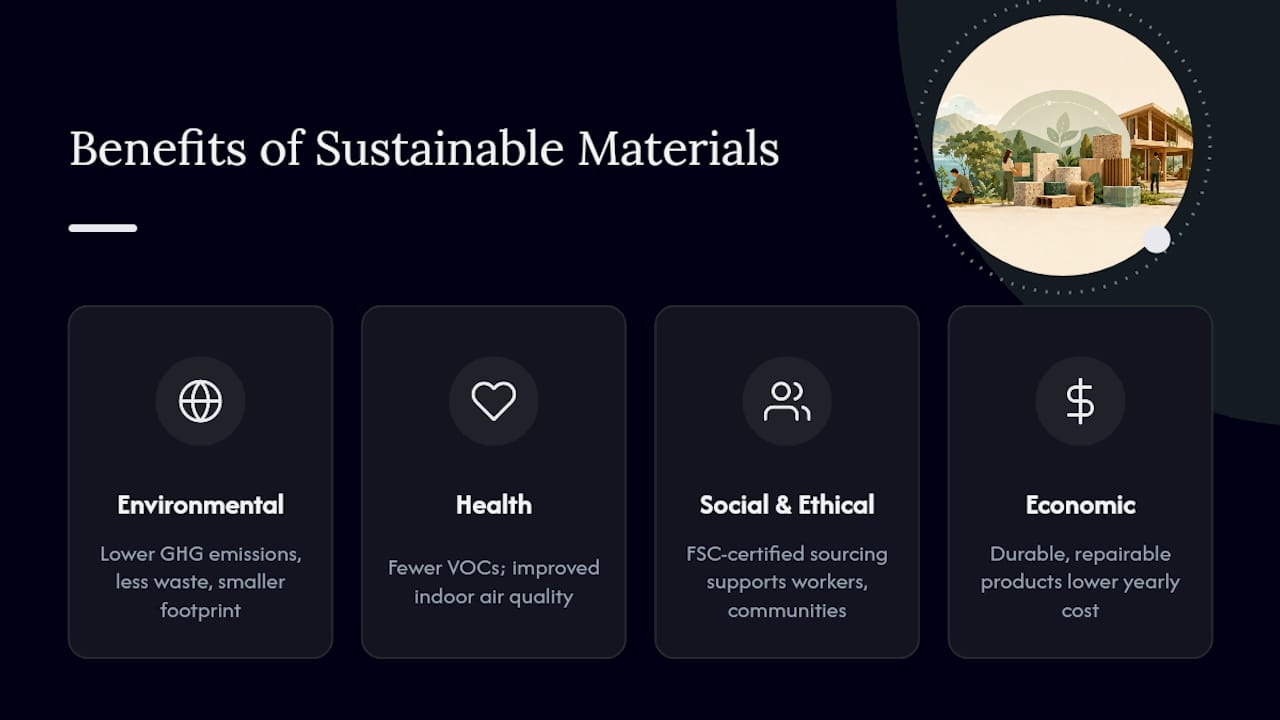
Health: Fewer VOCs and toxic additives mean better indoor air quality. This matters most in enclosed spaces where you spend significant time, like a bedroom or home office. Low-VOC inks used in custom prints, for example, reduce off-gassing after the product arrives in your home.

Social and ethical: FSC certification, for instance, requires that forests are managed with attention to workers’ rights and community impacts, not just timber yield. Choosing certified materials supports those standards financially. As the United Nations University has noted, integrating sustainability into material selection is both an ethical and strategic obligation, not a lifestyle add-on.
Economic: Durable, well-made products from quality materials tend to last longer, which lowers cost per year of use. Products that are repairable or recyclable also hold value better at end of life.
Pro Tip: When evaluating a print or framed piece, ask specifically about the ink type and frame material. Water-based or vegetable-based inks and FSC-certified frames are the two highest-impact swaps for eco-friendly decor in a home setting.
Common eco-friendly material types and what they look like in home decor
For wall art and small household items, the relevant material categories are more specific than the broad sustainability conversation usually gets.
- Recycled-content paper: post-consumer waste paper used for prints; look for the percentage of recycled content on the product page or packaging
- FSC-certified paper and wood: independently verified chain of custody from responsibly managed forests; applies to both print substrates and frames
- Soy-based and vegetable-based inks: replace petroleum-derived solvents with plant oils; lower VOC emissions during printing and in the finished product
- Low-VOC coatings and varnishes: water-based alternatives to solvent lacquers; relevant for frames, finishes, and protective coatings on prints
- Reclaimed wood: salvaged timber that avoids new extraction entirely; common in rustic or artisan frames
- Rapidly renewable materials: bamboo and cork regenerate in years rather than decades; used in frames, mounting boards, and decorative elements
- Recycled metals: aluminum and steel with high recycled content; relevant for metal-frame options
For packaging, recyclable and compostable materials are increasingly available from small retailers. Recyclable packaging options for retail goods follow similar principles: material type, certification, and local processing capacity all determine whether the claim holds up.
A practical guide to sustainable print materials covers paper choices, ink types, and print processes in more depth for anyone making purchasing or design decisions.
How to evaluate and choose truly sustainable materials
The most useful framework here is LCA, Life Cycle Assessment, stated plainly: it’s a method for adding up all the environmental inputs and outputs of a product from raw material to disposal. You don’t need to run one yourself, but understanding that it exists helps you ask better questions and interpret certifications correctly.
A practical buyer checklist for wall art, frames, or any small home good:
- Performance and durability: Will it last? A product that lasts twice as long at 1.5 times the price is the better environmental choice in most cases.
- Embodied impacts: Does the seller disclose the material origin? FSC certification or recycled-content percentage are the clearest signals.
- Toxicity: Are inks, coatings, and adhesives water-based or low-VOC? Ask directly if it’s not listed.
- End-of-life: Can the frame be recycled locally? Is the paper compostable or recyclable in your municipality?
- Social sourcing: Does the certification cover labor conditions, not just environmental metrics?
Key certifications to recognize:
- FSC (Forest Stewardship Council): covers paper and wood; verifies responsible forestry and chain of custody
- Cradle to Cradle: evaluates material health, recyclability, renewable energy use, water stewardship, and social fairness across five categories
- ENERGY STAR: relevant for energy-using products and appliances; signals verified efficiency against EPA standards
- Low-VOC / Zero-VOC labels: look for third-party verification, not just a brand claim; GREENGUARD Gold is one recognized standard for indoor air quality
The DOE’s Materials Substitution Working Report makes the case that material selection should be design-integrated and application-specific, comparing candidates on a functional-unit basis rather than weight-for-weight. That’s the same logic behind choosing a lighter, durable frame over a heavier one: the right comparison is performance per year of use, not grams of material.
Pro Tip: A certification on one component doesn’t cover the whole product. An FSC-certified frame can still use solvent-based adhesives or non-recycled backing board. Ask about every component, or look for sellers who disclose their full material stack.
Costs, financial trade-offs, and available incentives
Eco-friendly materials often cost more upfront. That’s real, and pretending otherwise doesn’t help anyone. A FSC-certified hardwood frame typically costs more than an uncertified MDF alternative at the same size. The question is whether that premium pays back over time, and for durable goods, it usually does.
The hidden costs of conventional materials include:
- Shorter product lifespan requiring earlier replacement
- Health-related costs from chronic low-level VOC exposure in poorly ventilated spaces
- Disposal costs when a product can’t be recycled and goes to landfill
On the incentive side, ENERGY STAR’s rebate finder is the most practical starting point for U.S. consumers looking to offset upfront costs on energy-related purchases. State and utility programs vary significantly, so searching by ZIP code gives you the most accurate picture of what’s available where you live. Federal tax credits for energy efficiency improvements have also expanded in recent years under the Inflation Reduction Act, though those apply primarily to home systems rather than decor.
For smaller purchases like prints and frames, the financial case rests less on rebates and more on durability and repairability. A well-made, certified product you keep for ten years beats a cheap one you replace three times.
What studies and programs show about greener purchasing
The EPA’s guidance on greener product purchasing is direct: buying greener products reduces harm to human health and the environment, and when adopted at scale, the results are measurable. The agency’s Safer Choice program, for example, evaluates chemical ingredients in products and certifies those that meet safety standards, giving consumers a verified signal rather than a marketing claim.
The DOE’s Materials Substitution Working Report adds important nuance: lightweight material substitutions can reduce emissions during a product’s use phase while incurring manufacturing penalties. That trade-off is worth knowing because it means the best material choice depends on where in the life cycle the biggest impact sits.
The practical implication: greener purchasing works best when it’s consistent, not occasional. One certified purchase matters less than a consistent preference for certified materials across the products you buy regularly.
Trade-offs and limitations: why no single material is always the answer
The most important thing LCA research has established is that there is no universally superior material. Context determines impact, and several well-documented findings complicate the simple “natural is better” assumption.
A peer-reviewed analysis by Meng et al. (2024) found that replacing plastics with currently available alternatives increases greenhouse gas emissions in many applications. The reason: plastics are lightweight and durable, and their alternatives often require more material mass or more energy-intensive production to achieve the same function. The study’s policy conclusion points toward reuse, recycling, durability, and decarbonizing production rather than blanket substitution.
Similarly, a Springer LCA study on biodegradable alternatives found that their net benefit depends strongly on local waste-management infrastructure. A compostable mailer that ends up in a landfill because your municipality doesn’t accept compostables produces methane as it degrades, which can be worse than a conventional plastic alternative that gets recycled.
Bio-based feedstocks carry their own burden shifts: agricultural land use, water consumption, and pesticide use can offset carbon benefits depending on the crop and farming practices. There is no silver-bullet material, and evaluating sustainability requires life-cycle thinking that accounts for these shifting burdens.
Pro Tip: Before choosing a “compostable” or “biodegradable” product, check whether your local waste management system can actually process it. Search your city or county’s waste management site for accepted materials before assuming the label translates to a real environmental benefit.
Simple actions you can take right now
These are prioritized by impact and ease, not comprehensiveness.
- Choose FSC-certified frames and paper. The certification is verifiable and covers both environmental and social standards. Look for the FSC logo on the product or its packaging.
- Prefer water-based or vegetable-based inks. Ask sellers directly, or look for low-VOC or soy-ink disclosures on product pages. This is the single highest-impact swap for indoor air quality in printed goods.
- Ask about VOCs and finishes before buying. A quick question to a seller about their coating or adhesive type tells you a lot about how seriously they take material transparency.
- Buy durable, not disposable. A well-made piece you keep for years beats a cheaper one you replace. Longevity is a sustainability strategy.
- Check local recycling before you buy. Verify that the frame material or packaging can actually be processed in your area before assuming it will be.
- Keep receipts and product details. Some municipalities and retailers offer take-back or recycling programs; having the product information makes participation easier.
For a deeper look at how these principles apply specifically to wall art and prints, Wallfully’s guide to eco-friendly wall art for conscious homes covers material choices and what to look for when buying personalized decor.
One more point worth making: personalized, made-to-order products can reduce overproduction and waste by aligning production with actual demand rather than speculative inventory. A custom print made when you order it generates less waste than a mass-produced item that sits in a warehouse and gets discarded unsold.
The part of this conversation most people skip
Most sustainability content focuses on the obvious wins: recycled paper, certified wood, lower emissions. Those matter. But the part that gets glossed over is the infrastructure dependency problem, and it changes the calculus significantly.
A “compostable” product that can’t be composted locally is not a sustainable choice. A “recyclable” frame made from a material your municipality doesn’t collect is landfill-bound regardless of what the label says. The gap between what a material can do and what it will do in your specific location is where most well-intentioned purchasing decisions fall apart.
The research on plastics substitution makes this concrete: the instinct to replace plastic with something that feels more natural often increases emissions when you account for the full life cycle. That doesn’t mean plastic is fine. It means the answer is almost never a simple swap. Reuse, durability, and recycling infrastructure matter as much as material choice.
At Wallfully, the commitment to eco-friendly materials in prints and frames reflects exactly this kind of thinking: it’s not enough to use a certified paper if the ink, coating, and packaging aren’t held to the same standard. The whole product stack matters.
Sources
- Materials Substitution Working Report (U.S. Department of Energy, 2023)
- Why Buy Greener Products? | US EPA
- Replacing plastics with alternatives is worse for greenhouse gas emissions in most cases (Meng et al., 2024)
- ENERGY STAR rebate finder